Pandemic Book Recommendation #9, Part 3: Hope
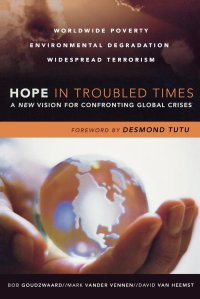
Every day during this pandemic, I find it more difficult to see hope, especially when it comes to COVID-19’s spread across America. My oldest daughter is in Phoenix, and my family, including my parents, are spread across West Virginia and Kentucky. The slow daily crawl watching the case numbers climb is like a dawdling spiritual poison from a drug that takes weeks to finish its work. Nonetheless, hope is always available if we are willing to seek it out. I’m trying. Bob Gouzwaard, Mark Vander Vennen and David Van Heemst remind us that hope is real because, “at its core, it is not a human creation. It attaches itself directly to the faith that God is deeply engaged in all of human history.” (172)
The conclusion of their book contains themes and metaphors of hope that apply to the tragic realities of pandemic. Some of their tropes are extraordinary and have consumed a few classes worth of past discussions in my courses. There is no space here for unpacking the circle and the cross (175), the periscope (181), the minesweeper (184), or the rope-ladder (187). Here I will only stick to two that seem most pertinent.
The Morning Star
There are beautiful signs of hope in the form of front-line health care workers sacrificing their own lives and safety to serve others – but even these stories exist in the context of tragedy. My Facebook feed is awash in the language of fear, blame and shock. When will this end? Where is God?
The authors of Hope in Troubled Times remind us that “Christian hope is a hope of contrast: it revives in the middle of the night, just when darkness seems to overpower us.” (176) They use the Biblical image of the morning star, which appears at the bleakest hours of the night, as a demonstration of the defeat of darkness. When the star appears, the morning is behind it. In the last words Jesus spoke to his disciples, he proclaimed, “I am… the bright morning star.” (Rev. 22:16)
The book of Esther in the Bible does not contain a mention of God. Yet, Esther’s name means “morning star.” She lived when the elimination of Israel appeared as fate. God seemed absent – but was there all along. “Miracles did not save Israel, at least not miracles as we understand them. But as a God who works hiddenly, God linked his saving acts to the act of Esther, who in obedience put her own life in jeopardy… When Esther is seen in the darkness of exile, that is the sign of daybreak. Where God in his hiddenness can be delineated, there is sign that the defeat of the night has come.” (177) Our front line health care workers are the Esthers of our day – the bright morning stars revealing the light that, though dim now, is soon to awaken the morning.
The Fruit Tree
I have suggested through the lens of this book that we are living in an age in which progress and material prosperity is the reigning ideology, perhaps to the point where economic growth has become an idol. This tragic pandemic can act as a catalyst for us to search our hearts about how we want to live in the coming post-COVID-19 world. The authors provide the fruit tree as a helpful metaphor in this regard.
“No fruit tree is inclined to grow infinitely in height. If it did so, it would have to jettison all of its inefficient cells. It would have to put greater pressure on the soil and forgo the production of fruit entirely. Instead, at a certain point a fruit tree exercises built-in wisdom to redirect its growth energies away from expansion in height and toward the production of fruit. It reaches a saturation point and recognizes it as such. This allows the tree to create room to build up reserves and then to redirect its growth energies toward the production of fruit.” (191)
Like fruit trees, our economies – at the scales of the household and the nation – were not intended to grow infinitely forever. Like trees, we arrive at saturation points in which we have a choice to re-orient our energies toward the production of fruit rather than infinite growth. The authors suggest we “take one decisive, perhaps painful, but also realistic step back from the economic goal that hypnotizes us.” On the other side of this pandemic, we can choose to develop a pre-care economy as opposed to a post-care economy. This would place care needs first rather than last on a list of priorities. We could turn away from simplistic material expansion and toward sustainable economies that build community, meet the needs of the poor, and invest in the preservation of culture and the environment. Perhaps one of our problems is that “we have failed to imagine that the world can operate in any other way.” (192)
 Michael Ferber