Blog

Pandemic Book Recommendation #9: Hope in Troubled Times, Part 1: Idolatry

I started this blog as an attempt to stay mentally healthy and positive during a time of social distancing. Many others have used social media as a platform for humour in this time of trial, and I’ve enjoyed seeing and relating to the many Facebook memes involving homeschooling, cats and social distancing. It worked for a few days. But two days ago I “popped” watching events unfolding in my home country. The context involved the government abandoning the advice of health experts and reopening the US economy to jump-start economic growth.

In the late evening of March 23, I posted the following on Facebook, “What we saw today in President Trump’s speech reveals the true god America worships. What do you say about a society that is willing to offer human sacrifices to appease the invisible hand of the market so we can all go back to consumption at the malls and prosperity in the stock market? Sacrifice the creation to this god – of course! Sacrifice the poor – no problem! Now we also appear to be willing to sacrifice our parents and grandparents. When will we confess and repent?”

Needless to say, this post started a bit of a discussion – and not much of it was touchy-feely or positive. The statement encapsulates a breadth of literature that is worth considering in these difficult days of pandemic. So, I’m going to step away from the positive self-help books for a few days and try to be a bit more prophetic in this blog. No matter your religious persuasion (or the lack thereof), consider looking at the monumental decisions being made in the United States through the lens of idolatry.

In 2007 Bob Gouzwaard, Mark Vander Vennen and David Van Heemst wrote Hope for Troubled Times: A New Vision for Confronting Global Crises. The volume is as important today as it was a decade ago when I started using it in some of my courses. I’m not going to provide a full review of it here, but rather use the book as a lens to consider how our current reliance on progress and economic growth could be an idol, in the fashion of the gods our ancestors would have crafted from wood or stone. I’ll make subsequent posts linking this idolatry to ideology, and then discuss hope for moving forward.

To start, the authors do assert that nothing is inherently evil about the economy, money or the market (170). Nonetheless, like wood or clay, these things can be formed into an apparatus to be worshiped. They describe three steps through which idol worship unfolds. First, people objectify the god using material available in order to bring the god closer. The image acts as an access point or gateway to the divine. Then people venerate the idol by bringing it sacrifices. Finally, people gradually become “reshaped and transformed into the likeness of their gods” (40).

Idols have mouths, but cannot speak,
Eyes, but they cannot see;
They have ears, but cannot hear,
Noses, but they cannot smell;
They have hands, but cannot feel,
Feet, but they cannot walk;
Nor can they utter a sound with their throats.
Those who make them will be like them,
And so will all who put their trust in them. (Ps. 115:5-8)

The authors assert that fear is what drives the final step. The image of their god may remain opaque, but its representation becomes very real. “The power that people delegate to the idol is a power that both saves and destroys. As such, it instills deeper and deeper anxiety. The slightest misstep can trigger the wrath of the idol, a wrath that may bring people to ruin. Serving idols therefore always brings with it a form of hypnosis, a hypnotic narrowing of consciousness. People’s perception of reality shrinks into a matter of merely finding the right type of interaction with the idol. But by then the god has, to some extent, assumed control: it now largely charts its own autonomous course. When that occurs, fear becomes the chief characteristic of life, and the sense of betrayal is pervasive.” (41)

Today it is quite common to hear the market described using terminology usually reserved for the religious realm. This involves not only the market’s saving power but also the sacrifices needed to maintain it.

– “We must follow the dictates of the market.”
– “Only economic growth can save us.”
– “All groups in society need to make sacrifices for a better future.” (97)

We are hearing this very language right now in the debate to jump-start the economy at the expense of the lives of front line health care workers and seniors. These sound profoundly religious, and this is not accidental. “It hints at decisions made about ultimate meaning, done either openly or unconsciously, without which people do not see life as feasible. Imitation saviors still move among us, and we see them as entitled to demand sacrifices.” (98)

Goudzwaard et al. make a strong argument that in the west, we are now trapped inside the cocoon of a perspective that will only consider solutions in line with the way we define progress (25). We have become consumed and obsessed with reaching our goals regardless of the cost. They argue that this is idolatrous in the sense that we exalt our goals of endless progress and material prosperity as the very powers that will deliver us to this end. In this manner, we have become dependent on our creations. But at a cost!

“The gods never leave their makers alone. As soon as people put themselves in a position of dependence on their gods, invariably the moment comes when those things or forces gain the upper hand, when they begin to mold the lives and thoughts of their adherents. Humanly made things or forces begin to control their makers even to the point where they become powers of domination. Against them the human will weakens or even vanishes, while the initial goals tend to become bleak, obscured, or forgotten, building in the moment when the gods’ betrayal becomes transparent. But by then it could be too late.” (27)

These times call for serious introspection and reflection. The economy is a social construct. Have we crafted a god in the form of material prosperity? If so, are we truly willing to pay the price of tribute? Are we so obsessed with our individual net worth and our collective GDP that we are willing to make this level of sacrifice to jump-start the economy? The rest of the world is prioritizing the lives and wellbeing of citizens – the very things the market was originally intended to enhance. Will America offload its responsibilities to fellow citizens and allow a false god to dictate the horrible sacrifices required? If so, can we continue to claim that America is a Christian nation?

Coming Up:
Part 2: Ideology
Part 3: Hope in Troubled Times
Pandemic Book Recommendation #8: Radical Acceptance

I had a difficult December and January this year, with an unexpected change in my job position right before Christmas due to budget restructuring. This was before Christina’s job was eliminated due to the AB budget changes in health care and a global pandemic roared its ugly head. Tara Brach’s “Radical Acceptance: Embracing Your Life with the Heart of a Buddha” has been one of the most helpful books inspiring me to live into saying “Yes” to an ever-evolving future. And no, I am not a Buddhist – this book has a lot to offer to everyone.

I listened to this on Audible after it was recommended to me by (surprise!) my wife, Christina. Tara Brach is a Clinical Psychologist and the founder of the Insight Meditation Community. She became a helpful mentor as I listened to her book at the gym while on the treadmill or elliptical. (Remember when we could go to the gym? Sigh…).

What is Radical Acceptance? Tara defines it as, “Clearly recognizing what is happening inside us, and regarding what we see with an open, kind and loving heart.” Radical Acceptance is about leaning into the present moment to observe our experience clearly, and be compassionate to ourselves about that experience. Radical Acceptance involves the practice of mindfulness. Jon Kabat-Zinn, whom I discussed last week, teaches a form of mindfulness stripped of religion. Though I am neither a Buddhist nor a philosophical idealist, I have tremendous respect for the practice of mindfulness, which is reflected in some ancient Christian traditions such as contemplative prayer.

I believe three of Tara’s practices, in particular, are helpful during this time of pandemic:

First, the power of a pause: taking time to stop and remember where we are, what we are doing, and why we think it matters. All of our patterns are changing as we step into the “new normal” of social distancing and, perhaps at times, full social isolation.  The pause helps us to be present in these changes and find opportunities for peace and gratitude.

Second, an essential question: What would it be like if we could accept life at this moment exactly as it is? What if I (you?) stopped thinking about how this moment could be better? If only there were sports. Or more seriously, if only I could work another shift to pay rent.  What if we stopped resisting our reality and instead open ourselves to the joy, freedom, and possibility that is right here in this moment? No matter how dire our situation, we can find acceptance and, therefore, peace – radical acceptance.

Finally, Smiling. Seriously. Our world needs more smiles right now. Tara defines a smile as the, “unconditional friendliness that welcomes experience without fear.” You could change the world of those around you this day with a smile.

Pandemic Book Recommendation #7: When the Body Says No

In my book recommendation yesterday, I shared about a three-day hiking extravaganza in which my brother and I slogged through miles of the unbelievably beautiful Canadian wilderness. What I didn’t share was that the week after this trip, my body shut down. Only it didn’t start with my body – it started with my mind.  On Friday, on the way up to the top of Ha Ling, I received a text requesting that I present something at a meeting at work Monday afternoon. I had already called off work that day, but because I have some people-pleasing issues, I said “OK”. I was unprepared for a presentation, but it would not be the first time I have winged something. After hiking all those kilometers, Andy and I stayed up until 1 am Sunday night talking, then woke up at 5 am. I dropped him off at the Calgary airport and drove to Edmonton, needing to pull off the road twice for twenty-minute cat naps. I made it to the meeting, but as I started my presentation my mind literally shut down. I was unable to talk and even began to have trouble breathing. I thought it was a panic attack, which threw me for a loop because I have been a public speaker for years. The experience stressed me out and I had trouble sleeping the week after. The following Saturday, at our university’s annual banquet, it happened again – only this time in front of 400+ people, including our university’s board of governors and donor base. It was a humiliating experience.

Sentinel Pass

I spent the next month trying to sort out what happened. Was I having a mental breakdown? Is there something wrong with me – a brain tumour or something scary? Following a session with a Psychiatrist, some Cognitive Behavioural Therapy with a Psychologist, and a thorough medical exam, a cause was determined – and you already know what it is. It turns out middle-aged chubby guys should not try to keep up with younger marathon runners in the mountains, then make presentations at work on almost no sleep.  Who knew!?

Eiffel Lake

During my time of healing and discernment, someone recommended Gabor Maté’s book. It is similar in some ways to Bessel van der Kolk’s The Body Keeps the Score; only Gabor Maté was not fired for bullying and mistreating his employees (yikes!). Maté is a Vancouver physician who has, throughout his career, advocated that we are holistic organisms with intricate connections between mind, body, and spirit. He uses examples of famous people such as Gildna Radner, Ronald Reagan and Stephen Hawking to illustrate chapters on stress, negative thinking, emotional repression, relationships, etc. Maté manages to walk the fine line between blaming someone for their illness and analyzing the broader factors leading to increased health risk.

There is a lot to consider from this book during a time of pandemic. Perhaps top of the list is Gilda Radner’s advice: “It is important to realize that you have to take care of yourself because you can’t take care of anybody else until you do.” This is a time of incredible levels of stress and anxiety as we collectively – and almost instantaneously – try to adjust to new ways of working from home, parenting, and interacting with one another. And, we’re doing this in the context of a terrifying and deadly pandemic. Our patterns of processing this kind of stress may not have been healthy in the best of times, and now, with metaphorical fans covered in poo, our bodies may begin to say “No.” Perhaps they were saying “No” last week, and now they are saying, “Hell No!” We mustn’t ignore what our bodies are trying to communicate.

Maté begins most chapters with rather sad stories of pain, abuse, repression and loss. So, during this time in history, give yourself permission to skip the depressing stuff and raid the book for its best part. In the last chapter, he provides advice on confronting the stress patterns that haunt us.

You don’t have time to read the book while working from home and taking care of kids? No problem. You can find some of his resources HERE on his website.

Free Books for Kids on Audible

Audible just made many of their children and teen books free!

https://stories.audible.com/discovery

Categories include Littlest Listeners, Elementary, Tween, Teen and Literary Classics.

This service could be a God-send to those of us figuring out how to multi-task and homeschool. But even for adults, there are some good reads in the list of free classics, including Roots, The Call of The Wild, Brave New World, and The Jungle. Are you really looking for something to do? Moby Dick is a 24 hour listen.

Pandemic Book Recommendation #6: The Sacred Year

On Saturday I posted my first pandemic book recommendation on James K.A. Smith’s “You Are What You Love.” Today’s suggestion follows along in that same vein – ideas for developing healthy spiritual disciplines while we are already social distancing. By the way – Rev. Jonathan Crane (Rector of St. Augustine of Canterbury Anglican Church in Edmonton) saw my post and invited me to chat about it with him on his church’s podcast. Check it out!

In today’s recommendation, Mike Yankoski has provided a helpful guide for exploring traditional and modern spiritual disciplines. As an evangelical motivational speaker, the author became frustrated by the lack of depth in his own spiritual life and in his tradition. He opens with a painful example while on the road with other Christian motivational speakers. To remedy the shallowness he decided to spend an entire year researching and practicing a variety of disciplines, and so “The Sacred Year” recounts this adventure exploring depth in himself, God and others.

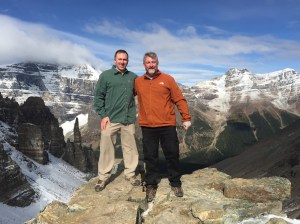
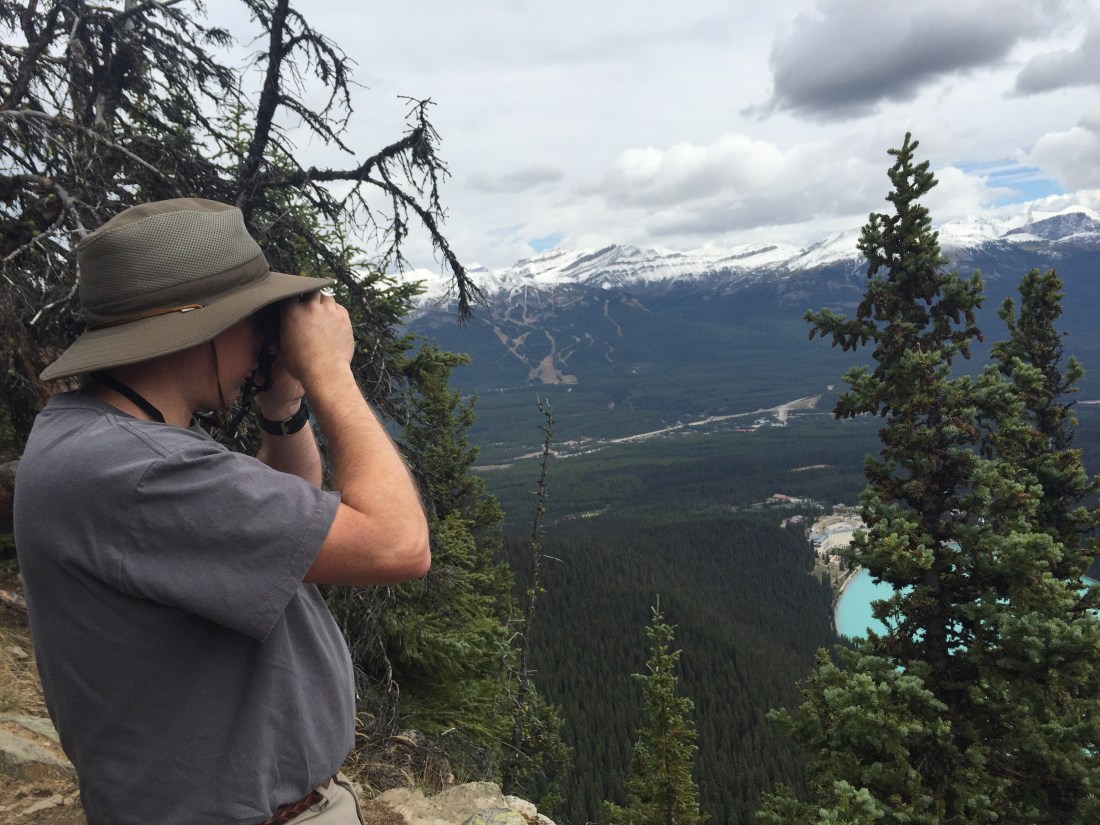
I “read” the book while hiking in the Canadian Rockies with my brother Andy in the Fall of 2017. As we summited Ha Ling over Canmore, reached Sentinel Pass above Larch Valley, and managed to top both of the Beehives then traverse the Valley of the Ten Glaciers above Lake Louise (all in three days) I listened to the entire book – twice! I’m an extrovert, so on these adventures I’m as social as can be in the mornings, evenings and during trail breaks. But, while hiking, I enjoy keeping to myself by listening to books, podcasts, or music (and yes – I do unplug and enjoy the sounds of nature as well). When I hike with Andy, going solo is out of necessity. He is five years younger, fifty pounds lighter, and a marathon runner. Thankfully he was patient enough to wait on me numerous times over the 110 km we hiked those three days.

Ha Ling above Canmore

Here are the disciplines I reflected on in that wilderness while “reading”: Attentiveness, Daily Examen, Sustenance, Simplicity, Creativity, Embracing Mortality, Confession, Listening Prayer, Lectio Divina, Regular Eucharist, Solitude, Sabbath, Wilderness, Pilgrimage, Gratitude, Protest, Pursuing Justice, Community, Caring.

I imagine many of us practice quite a few of these regularly, but now that we are social isolating for the pandemic, we have an extraordinary opportunity to dig a little deeper. Some of our households are already in need of a silent retreat! And though uncomfortable, who isn’t considering their mortality right now? Yankoski is a bit intense about some of these. For instance, he lives in a cave for a week to practice silence and digs a grave to practice embracing mortality. I’m writing this with two kids and a dog in my office – the cave sounds great! But you might start a panic in your neighbourhood if you start digging a grave out back – not recommended at this time.

Overall, this is a well written and helpful book. It recounts an evangelical’s experience as he rediscovers a depth of historic spiritual practice and brings others along for the ride. This is an excellent choice if you want to use your time of forced solitude to develop healthy habits and disciplines for other side of “the new normal.”

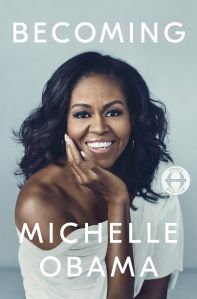
Pandemic Book Recommendation #5 – Becoming by Michelle Obama

(First published March 18, 2020 on Facebook)

This is just a quick one today. Yesterday Facebook sent me two notices that I broke the community standards by sending out Spam. They specifically referenced my book recommendations for Full Catastrophe Living and The Nix. What is funny is that they sent me a copy of the community standards and their aim to create a space for expression and give people a voice to build community and bring the world together. But that is what I was trying to do! ??? I think what happened is that I started each post with the same verbatim line and then provided links to a corporate website (amazon). My guess is a bot picked it up and flagged it as Spam. Otherwise, someone actually reported it as Spam, which would be kind of sad because I am recommending books to read to stay sane during a pandemic. One of you must really hate books!!! Either way, I’m not going to give up. I’m in the process of creating a WordPress blog site for these so Zuckerberg keeps his hands off them. If you can no longer see those posts they will be on the blog soon. But for now, here is my day #5 recommendation!

“Becoming,” by Michelle Obama, is the best autobiography I read this year. I have a ton of conservative friends whom I love and value, and I especially hope some of you will take the time to read Michelle’s story. You may discover Michelle is not the monster you have heard about in the media. She does not hate America and, believe it or not; she was not even very enthusiastic about Barrack running for office. Here is my challenge to my conservative friends: you read this and then message me a book you’d like me to read. When we’re both finished, we can have a Zoom conversation about the books and discover some things we have in common.

Ferber's Pandemic Book Recommendation #4 – Full Catastrophe Living by Jon Kabat-Zinn

(First published March 17, 2020 on Facebook)

Jon Kabat-Zinn’s classic book seems like an appropriate read right now based on the title alone. Does it not feel as though we are all already living the full catastrophe!? Kabat-Zinn is the founder of the Stress Reduction Clinic at the University of Massachusetts Medical Center. I discovered the 600+page tome when I tagged along with my wife Christina in an eight-week intensive MBSR (Mindfulness-Based Stress Reduction) training. It was quite a commitment as we had to practice mindful meditation for over an hour a day and participate in some intense group work every week. I went into it skeptical; I came out transformed.

The inspiration for the title comes from the 1964 film Zorba the Greek. When asked if he is married, Zorba (played by Anthony Quinn) responds, “Am I not a man? And is not a man stupid? I’m a man, so I’m married. Wife, children, house–everything. The full catastrophe.” Kabat-Zinn turns this on its head and spins it positive by offering resources for each of us to find control and calmness through relaxation, awareness, and the practice of being in the present. Thus, we become better equipped to be at peace in the “full catastrophe” – the spectrum of stress in life, which is unavoidable to all of us.

There is a reason my wife, a Psychologist, is interested in mindfulness. MBSR is rooted in many principles linked to cognitive behavioural therapy. Kabat-Zinn primarily works with individuals who have experienced medical dilemmas, but it is also valuable for other kinds of stressful circumstances that people cannot control (pandemic, anyone?). Through mindful meditation, we can find ways to reframe our circumstances and keep them in their proper place. By learning to listen to our bodies, we can grow in our capacity to “take on the full catastrophe” and deal with fear, panic, anxiety, and stress. We can learn to shift from an emphasis of “doing” to a focus on “being” – a timely skill for the coming weeks and months. Mindfulness helps us adjust to our suffering and walk more compassionately with others who are in physical or emotional pain.

Ferber’s Pandemic Book Recommendation #3 – The Gift of Fear by Gavin de Becker

(Originally posted March 16, 2020 on Facebook)

This book, first published in 1997, was written before Y2K, 911, or the conception of Gen Zs – let alone COVID-19. Yet, it remains a timely read for thinking about fear and our responses to it. Bonus: it is so old you can find free copies online (https://epdf.pub/gift-of-fear.html).

Gavin De Becker is the world’s expert on threat assessment. He was hired by countless movie stars and government officials to protect lives from stalkers and assassins. His book is full of harrowing real-life stories of people who were in danger when, either fear kicked in and they were able to find a way to survive, or they ignored their intuition to their own peril. The premise of his book, as captured in the title, is that fear is a gift and when it is respected it can save your life. But here is the kicker, and the reason the book is so relevant right now: We need to be able to differentiate between truly life-threatening situations and good old-fashioned worry.

I picked this book up last fall when I was still the Dean of Students at The King’s University. It interested me because, as a society, we seem to have forgotten how to differentiate the two. As DoS, I regularly worked with young adults who lived in a fragile emotional state of non-life-threatening fear. DeBecker asserts that what we truly fear is what we link to fear rather than what we think we fear. Read that last sentence twice then consider public speaking as an example. It’s not actually simple embarrassment that we fear. We don’t want to be perceived as incompetent, and this is linked to other fears such as not graduating or losing employment. This may be further linked to our identity – if we fail at public speaking then, perhaps, we could lose our very self! Our fears have a way of snowballing. When we realize what we really fear we can name it, and then work on changing our mindset up the chain of causality.

Back to COVID-19. Is it life threatening? Yes! But not to everyone equally. If you are reading this and you are an older adult your intuition should be telling you to isolate yourself or face a real statistical possibility of losing your life. If you are younger it is less likely that you will die from this pandemic, though evidence from China and Italy demonstrates there is a threat as some front-line workers in their 20s and 30s have died. In the case of real threats fear can help us make decisions to stay alive. As an older adult you may want to head to Lowes to work on a basement reno, and listening to the intuition in your gut that says this is a bad idea could be a life-saving decision. (No Dad, this example is not just a coincidence – please save the basement reno for fall!). For all of us there are plenty of other things to fear including loss of loved ones, loss of employment, loss of social interaction, running out of toilet paper, and on and on. If your life is in danger, listen to the gift fear is intuiting and isolate. If your fears are linked to something else please still isolate (for the sake of all our loved ones), but also consider naming your fears as this might help differentiate between fear as a gift and fear as worry. Knowing there are things we can do to make our situation better can alleviate both life-threatening fear and the worries associated with other fears. Washing your hands, practicing social isolation, looking out for your neighbors, and practicing self-care (praying, reading, meditating, exercising, etc.) are things we can do to get through these difficult weeks without finding ourselves locked in fear.

Ferber’s Pandemic Book Recommendation #2 – The Nix by Nathan Hill

(Originally posted March 15, 2020 on Facebook)

I finished The Nix a few weeks ago, and I miss it. It’s a 22 hour listen on Audible or a 600+ page read – perfect for avoiding Sabbatical writing or the constant barrage of pandemic news. The heartbreaking yet hysterical life of Community College English Professor Samuel Anderson-Andreson entertained me every day while Poppy and I journeyed through several of Edmonton’s dog parks. Frequently dog companions gave me side looks as I passed them literally laughing out loud. Poor Poppy was forced to walk countless extra kilometres when we would get back to the car, then suddenly take another lap because I couldn’t take off my headphones until I digested one more chapter.

Nathan Hill is an extraordinary master of satire who somehow manages to weave three different yet coherent stories of comedic tragedy into this intergenerational exploration of college life during the distinct eras of the Boomers, Gen X, and Millennials. My favourite scene involves Samuel’s struggle to address a plagiarized paper with Laura Pottsdam, a stereotypically entitled millennial student who manages to unconsciously utilize every conceivable logical fallacy in her attempt to avoid consequences. She eventually gets away with it when she convinces Samuel’s Dean that he caused her to experience “negative feelings of stress and vulnerability.” Samuel’s only escape – from his students, from the book he is supposed to be writing (and for which he already received an advance), from the pain of his mother abandoning him, and from the loss of the only girl he will ever love – is a video game called ElfScape. His best friends are people he has never met in the real world. But then his mom re-enters his life through the television via a ridonkulous political drama that plays out on the national American stage, and which engulfs him in a pilgrimage to understand his past. The story moves back and forth in time as the mysteries of Samuel’s genealogy illuminate his tragic life. Hill manages to weave a tapestry integrating themes like friendship, love, addiction, abandonment, loneliness, identity, vocation, female oppression, frozen food, war, and politics in settings as far-ranging as pre-World War II Norway, the 1968 Chicago Democratic Convention, post-911 Iraq, and the Occupy Wall Street movement.

The Nix is fitting pandemic reading because Hill has a way of illustrating the paradoxes of our contemporary world through the developing eyes of childhood, young adulthood, middle age, and senility. As we social distance for the sake of our parents and grandparents, this novel may be a helpful lens to consider what is truly important in life – and what is not.

Ferber’s Pandemic Book Recommendation #1 – You Are What You Love by James K.A. Smith

(Originally posted on FaceBook March 14)

I read WAY too much – usually two or three books a week. I have at least three or four volumes lying around different rooms of my house, and whenever I’m exercising or taking Poppy to the dog park I bring along my headphones and listen to authors on Audible. These last two months while on Sabbatical I’ve been an especially prolific reader – an escape from my primary task of writing. Since we’re all now social distancing, I thought I’d start posting recommendations. I don’t plan to write book reviews, but I’ll mention reasons I think a volume is timely and interesting.

My day #1 pick is You Are What You Love by James K. A. Smith. I thought of this book yesterday when Christina and I went out to buy a few necessities at the Grocery Store (Noodle Bowls for Brendan, Mac & Cheese for Tessa, Coffee Creamer for Wayne & Dorothy, and Cinnamon Buns – the necessities of apocalyptic living). I was aware of the panic shopping happening in the States but was naïve to its presence in Edmonton. Toilet paper? Really? Standing in a completely bare aisle reminded me of Smith’s concept of cultural liturgies. Our hearts are like a compass and our habits can reveal our deepest desires, including the idols we may not even realize we “worship” through the liturgies (daily habits) of our lives. Consumption tops Smith’s list – he argues that as a society we tend to find meaning and purpose in our shopping and consumption. What does the fascinating and ridiculous toilet paper panic of 2020 tell us about ourselves? What does it mean that when we are afraid, we go shopping? Check out Smith’s book and see if there are some provoking questions and ancient answers.

I wrote a slightly longer review on this one for student development professionals here:

https://www.thecacsd.org/blog/you-are-what-you-love-by-james-ka-smith-book-review-by-michael-ferber