
Pandemic Book Recommendation #7: When the Body Says No

In my book recommendation yesterday, I shared about a three-day hiking extravaganza in which my brother and I slogged through miles of the unbelievably beautiful Canadian wilderness. What I didn’t share was that the week after this trip, my body shut down. Only it didn’t start with my body – it started with my mind.  On Friday, on the way up to the top of Ha Ling, I received a text requesting that I present something at a meeting at work Monday afternoon. I had already called off work that day, but because I have some people-pleasing issues, I said “OK”. I was unprepared for a presentation, but it would not be the first time I have winged something. After hiking all those kilometers, Andy and I stayed up until 1 am Sunday night talking, then woke up at 5 am. I dropped him off at the Calgary airport and drove to Edmonton, needing to pull off the road twice for twenty-minute cat naps. I made it to the meeting, but as I started my presentation my mind literally shut down. I was unable to talk and even began to have trouble breathing. I thought it was a panic attack, which threw me for a loop because I have been a public speaker for years. The experience stressed me out and I had trouble sleeping the week after. The following Saturday, at our university’s annual banquet, it happened again – only this time in front of 400+ people, including our university’s board of governors and donor base. It was a humiliating experience.
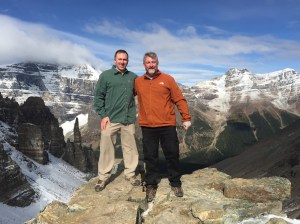
Sentinel Pass

I spent the next month trying to sort out what happened. Was I having a mental breakdown? Is there something wrong with me – a brain tumour or something scary? Following a session with a Psychiatrist, some Cognitive Behavioural Therapy with a Psychologist, and a thorough medical exam, a cause was determined – and you already know what it is. It turns out middle-aged chubby guys should not try to keep up with younger marathon runners in the mountains, then make presentations at work on almost no sleep.  Who knew!?

Eiffel Lake

During my time of healing and discernment, someone recommended Gabor Maté’s book. It is similar in some ways to Bessel van der Kolk’s The Body Keeps the Score; only Gabor Maté was not fired for bullying and mistreating his employees (yikes!). Maté is a Vancouver physician who has, throughout his career, advocated that we are holistic organisms with intricate connections between mind, body, and spirit. He uses examples of famous people such as Gildna Radner, Ronald Reagan and Stephen Hawking to illustrate chapters on stress, negative thinking, emotional repression, relationships, etc. Maté manages to walk the fine line between blaming someone for their illness and analyzing the broader factors leading to increased health risk.

There is a lot to consider from this book during a time of pandemic. Perhaps top of the list is Gilda Radner’s advice: “It is important to realize that you have to take care of yourself because you can’t take care of anybody else until you do.” This is a time of incredible levels of stress and anxiety as we collectively – and almost instantaneously – try to adjust to new ways of working from home, parenting, and interacting with one another. And, we’re doing this in the context of a terrifying and deadly pandemic. Our patterns of processing this kind of stress may not have been healthy in the best of times, and now, with metaphorical fans covered in poo, our bodies may begin to say “No.” Perhaps they were saying “No” last week, and now they are saying, “Hell No!” We mustn’t ignore what our bodies are trying to communicate.

Maté begins most chapters with rather sad stories of pain, abuse, repression and loss. So, during this time in history, give yourself permission to skip the depressing stuff and raid the book for its best part. In the last chapter, he provides advice on confronting the stress patterns that haunt us.

You don’t have time to read the book while working from home and taking care of kids? No problem. You can find some of his resources HERE on his website.

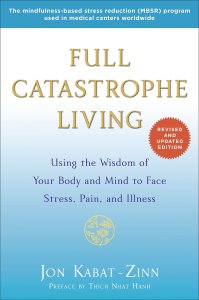
Ferber's Pandemic Book Recommendation #4 – Full Catastrophe Living by Jon Kabat-Zinn

(First published March 17, 2020 on Facebook)

Jon Kabat-Zinn’s classic book seems like an appropriate read right now based on the title alone. Does it not feel as though we are all already living the full catastrophe!? Kabat-Zinn is the founder of the Stress Reduction Clinic at the University of Massachusetts Medical Center. I discovered the 600+page tome when I tagged along with my wife Christina in an eight-week intensive MBSR (Mindfulness-Based Stress Reduction) training. It was quite a commitment as we had to practice mindful meditation for over an hour a day and participate in some intense group work every week. I went into it skeptical; I came out transformed.

The inspiration for the title comes from the 1964 film Zorba the Greek. When asked if he is married, Zorba (played by Anthony Quinn) responds, “Am I not a man? And is not a man stupid? I’m a man, so I’m married. Wife, children, house–everything. The full catastrophe.” Kabat-Zinn turns this on its head and spins it positive by offering resources for each of us to find control and calmness through relaxation, awareness, and the practice of being in the present. Thus, we become better equipped to be at peace in the “full catastrophe” – the spectrum of stress in life, which is unavoidable to all of us.

There is a reason my wife, a Psychologist, is interested in mindfulness. MBSR is rooted in many principles linked to cognitive behavioural therapy. Kabat-Zinn primarily works with individuals who have experienced medical dilemmas, but it is also valuable for other kinds of stressful circumstances that people cannot control (pandemic, anyone?). Through mindful meditation, we can find ways to reframe our circumstances and keep them in their proper place. By learning to listen to our bodies, we can grow in our capacity to “take on the full catastrophe” and deal with fear, panic, anxiety, and stress. We can learn to shift from an emphasis of “doing” to a focus on “being” – a timely skill for the coming weeks and months. Mindfulness helps us adjust to our suffering and walk more compassionately with others who are in physical or emotional pain.

Ferber’s Pandemic Book Recommendation #3 – The Gift of Fear by Gavin de Becker

(Originally posted March 16, 2020 on Facebook)

This book, first published in 1997, was written before Y2K, 911, or the conception of Gen Zs – let alone COVID-19. Yet, it remains a timely read for thinking about fear and our responses to it. Bonus: it is so old you can find free copies online (https://epdf.pub/gift-of-fear.html).

Gavin De Becker is the world’s expert on threat assessment. He was hired by countless movie stars and government officials to protect lives from stalkers and assassins. His book is full of harrowing real-life stories of people who were in danger when, either fear kicked in and they were able to find a way to survive, or they ignored their intuition to their own peril. The premise of his book, as captured in the title, is that fear is a gift and when it is respected it can save your life. But here is the kicker, and the reason the book is so relevant right now: We need to be able to differentiate between truly life-threatening situations and good old-fashioned worry.

I picked this book up last fall when I was still the Dean of Students at The King’s University. It interested me because, as a society, we seem to have forgotten how to differentiate the two. As DoS, I regularly worked with young adults who lived in a fragile emotional state of non-life-threatening fear. DeBecker asserts that what we truly fear is what we link to fear rather than what we think we fear. Read that last sentence twice then consider public speaking as an example. It’s not actually simple embarrassment that we fear. We don’t want to be perceived as incompetent, and this is linked to other fears such as not graduating or losing employment. This may be further linked to our identity – if we fail at public speaking then, perhaps, we could lose our very self! Our fears have a way of snowballing. When we realize what we really fear we can name it, and then work on changing our mindset up the chain of causality.

Back to COVID-19. Is it life threatening? Yes! But not to everyone equally. If you are reading this and you are an older adult your intuition should be telling you to isolate yourself or face a real statistical possibility of losing your life. If you are younger it is less likely that you will die from this pandemic, though evidence from China and Italy demonstrates there is a threat as some front-line workers in their 20s and 30s have died. In the case of real threats fear can help us make decisions to stay alive. As an older adult you may want to head to Lowes to work on a basement reno, and listening to the intuition in your gut that says this is a bad idea could be a life-saving decision. (No Dad, this example is not just a coincidence – please save the basement reno for fall!). For all of us there are plenty of other things to fear including loss of loved ones, loss of employment, loss of social interaction, running out of toilet paper, and on and on. If your life is in danger, listen to the gift fear is intuiting and isolate. If your fears are linked to something else please still isolate (for the sake of all our loved ones), but also consider naming your fears as this might help differentiate between fear as a gift and fear as worry. Knowing there are things we can do to make our situation better can alleviate both life-threatening fear and the worries associated with other fears. Washing your hands, practicing social isolation, looking out for your neighbors, and practicing self-care (praying, reading, meditating, exercising, etc.) are things we can do to get through these difficult weeks without finding ourselves locked in fear.