I’m Still Here: Black Dignity in a World Made for Whiteness

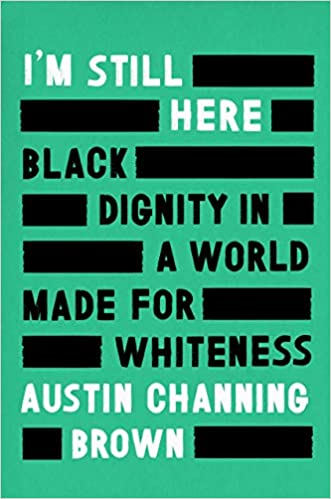
Pandemic Book Recommendation #20: I’m Still Here: Black Dignity in a World Made for Whiteness by Austin Channing Brown

Today is Juneteenth, and possibly (thanks to Donald Trump?) the first time the commemoration of the ending of slavery in the US is widely acknowledged by white Americans. Though emancipation has been celebrated since 1865, this year it is especially important considering how the legacy of slavery is continuing to create racial trauma throughout the US and Canada. 

In my hometown, there was an effort last week to have the statue of Stonewall Jackson, who was born in Clarksburg, removed from the courthouse. I walked past this statue every day for many years when I worked for the Harrison County Planning Commission. Like most citizens, I did not consider how the icon represented violence against the black citizens of my county of origin. Even relatives of Andrew Jackson testified to the County Commission asking for the statue to be removed, saying, “I also believe that a heroic statue of his cause in front of the courthouse sends a very specific message of white supremacy against the black population of the county.” Nonetheless, after an outcry from white residents (many of them high school friends in my Facebook feed asking us all to sign petitions to keep the statue), the Commissioners voted to keep it, which is unsurprising considering Harrison County is 95% white

Perhaps even more appalling were the words this week coming from one of my favourite pastor/worship leaders in the Evangelical Church. For years in my classes, I have used Louie Giglio’s Star and Whale mashup as a devotional. 

Louie Giglio’s Stars and Whales Mashup

I can’t use it again, not after Giglio came out two days after Raychard Brooks was murdered in Giglio’s city of Atlanta, saying shockingly that slavery was a blessing for whites. His exact words: “We understand the curse that was slavery, white people do and we say that was bad. But we miss the blessing of slavery, that it actually built up the framework for the world that white people live in.” WHAT!?!?!

Meanwhile, in my university community, we are being called out for lack of action on diversity. Though not named in the formal letter from students of colour, in a subsequent social media post, I was named (by name) as a leader at King’s who dropped the ball on this during my time as VP Student Life and Dean of Students. The criticisms are fair and just. 

As whites in North America, we are just not getting it – and I include myself in this statement. We are missing the big picture. White Christians in North America need to stop defending, stop talking, and start listening. A great place to start is Austin Channing Brown’s I’m Still Here: Black Dignity in a World Made for Whiteness. I finished it yesterday. You may think I am suggesting this because it is a book on race written by a white guy whom we may relate to, right? Wrong! Austin is a black woman whose parents purposely gave her a white man’s name to help her get to interviews in a white supremacist world. According to her own words, “it worked too well!”

Though not mentioned in the book, Austin worked for Calvin College for a time, and likely her experience there (in addition to several roles in ministry in white churches) helped provide quite a bit of the context for her perceptions of working as a black woman in Christian organizations. Friends from King’s – pay attention! Many of our black students have shared similar horrifying experiences. She includes chapters on how “White People Are Exhausting,” how to deal with “Nice White People,” and she walks through a profoundly disturbing portrayal of what it is like to live for one day as a black woman in a white Christian workplace. 

My favourite chapter was about reconciliation, a term that is prominent in my own university’s mission statement. Brown describes it as a buzzword, “a churchy sounding catch-all for diversity education.” She persuasively argues that reconciliation has been drained of its extraordinary power as revealed in Jesus going to the cross, the lion laying down with the lamb, and the power of swords transformed into plowshares. For Austin Channing Brown, radical reconciliation must choose sides, and not merely be a symbolic act of harmony. Acts of harmony do not change power structures. Too often, listening to the pain of people of colour ends up being the final step, not the beginning of real reconciliation that diverts power. Thus, as black students grievously experienced under my leadership, they end up hitting a wall. 

Every white Christian in North America should read this book slowly and carefully. Before opening it, we must surrender our tendency toward defensiveness and listen – intently, empathetically, and with a view toward true reconciliation. How have we internalized racism? How are we biased? As white people in North America, we have grown up in a society stacked in our favour, and for the most part, we are blind to it. If we are white, we have internalized racism, even if we don’t see it. But those who have experienced racial trauma see it very clearly. It is evident when we refuse to listen to this trauma and perpetuate white powers, symbols and structures on our courthouse steps, in our university policies and curriculum, and in the language we use about race and reconciliation. It’s time we stop exhausting people of colour in our white spaces and begin listening. Austin Channing Brown’s book is a great place to start. 
The Problem of Pain

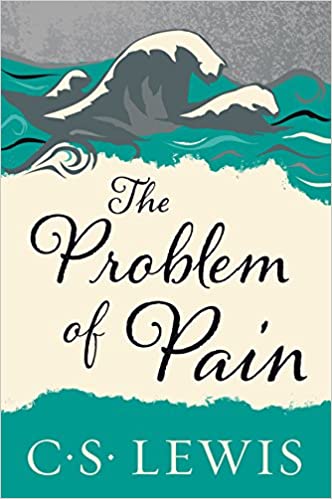
Pandemic Book Recommendation #19: The Problem of Pain, by C.S. Lewis

It has been quite a few weeks since I posted here, but like most things in this COVID world, it feels like months. For three weeks of this hiatus, I was teaching my annual Physical Geography class at King’s. The course is usually 50% outdoors and includes field trips to Jasper and Drumheller. This year’s COVID-19 edition was online – an entirely different experience! Early in the class, we had a good discussion on the age of the Earth. A theology student had some excellent follow-up questions that morphed into a conversation about evolution, the existence of a historical Adam, and The Fall. I pulled The Problem of Pain off my shelf to reference how C.S. Lewis managed to negotiate evolution and Genesis 1-3 way back in 1940. A few days ago, the volume was still by my recliner, and I got lost in it one afternoon, re-reading it cover to cover. It is a timely book for these days of ever-increasing pain.

I will leave the chapters on evolution and Adam alone, but for a more contemporary view of this checkout Richard Middleton’s lecture “Human Distinctiveness and the Origin of Evil.”

In this blog, amid the tremendous pain our world is experiencing, I want to focus on the idea of surrender as it relates to racial inequality. C.S. Lewis summarizes the problem of pain like this:

 “If God were good, He would wish to make His creatures perfectly happy, and if God were almighty, He would be able to do what he wished. But the creatures are not happy. Therefore, God lacks either goodness, or power, or both.” (16)

Lewis works his way through the free will theodicy and aspects of The Fall to wrestle with how pain, though not all of it, can be linked directly to human evil and free will. Lewis identifies some good that can come from the horror of pain, and this good is linked to a theology of surrender, which he extrapolates using three “operations” of pain. First, pain shatters the illusion that all is well (93). Second, pain shatters the illusion of self-sufficiency – that what we have in and of itself is good enough (96). Third, pain is necessary for us to fully act out self-surrender to God, using martyrdom as the ultimate example of following Christ (102).

Still, Lewis struggles to get past the idea that pain in every form sucks ass. Those are not entirely his words, but he does claim that if he knew any way of escaping pain, he would crawl through the sewers to find it (105) – so it is close. Pain is painful, but he also argues from classic Christian doctrine that suffering is what makes us everything we were meant to be – that tribulation is a necessary element in redemption (114). We crave security and a lack of suffering, but this settled happiness would teach us to rest our hearts in this world and oppose a return to God (116).

It has been twenty years since I read this book, but based upon my old scribbles in the margins, I have not learned much over this time. Like Lewis, I still prefer life without pain, adversity, trial, or tribulation. If I have learned anything in the last twenty years, though, it is the value of surrender – of being with God in the present and being OK with things as they are and not as I would like them to be (something I am much better at in theory than in practice). Contemplative prayer and mindfulness (Radical Acceptance) remind me of Lewis’s assertion that our highest activity is response, not initiative (44). This is love – not that we loved God, but that God loved us. We want to be nouns, but we are only adjectives (75).

There are times to radically accept our suffering, and in this, find the will of God. But there are other times when we are called to end the injustice and suffering of others. Blessed are the poor, says Jesus, but as His followers, we are tasked to help end poverty. It is this paradox that we find ourselves in today. Suffering has its place in helping us find submission in God’s will, but Lewis is clear (and I agree) that pain is not good in itself! “It would be a false view to suppose that the Christian understanding of suffering is incompatible with the strongest emphasis on our duty to leave the world better than we found it (114).”

For instance, the pain of my sisters and brothers of African and Indigenous descent will not find resolution through radical acceptance and surrender alone. No – the pain of a 500-year history of slavery, genocide and racism is deep, and we have hardly begun to scratch the surface of speaking the truth about this pain and suffering in North America. C.S. Lewis did not help us much here. He is a man of his times, and as you would expect for a Christian book written in 1940, he writes as a white man to other white men. It is time to listen to some other voices! (Though perhaps the world has not been as frightened, conflict-ridden, and painful since these words written in the advent of World War II.)  

Black Lives Matter Rally, Edmonton. June 5, 2020

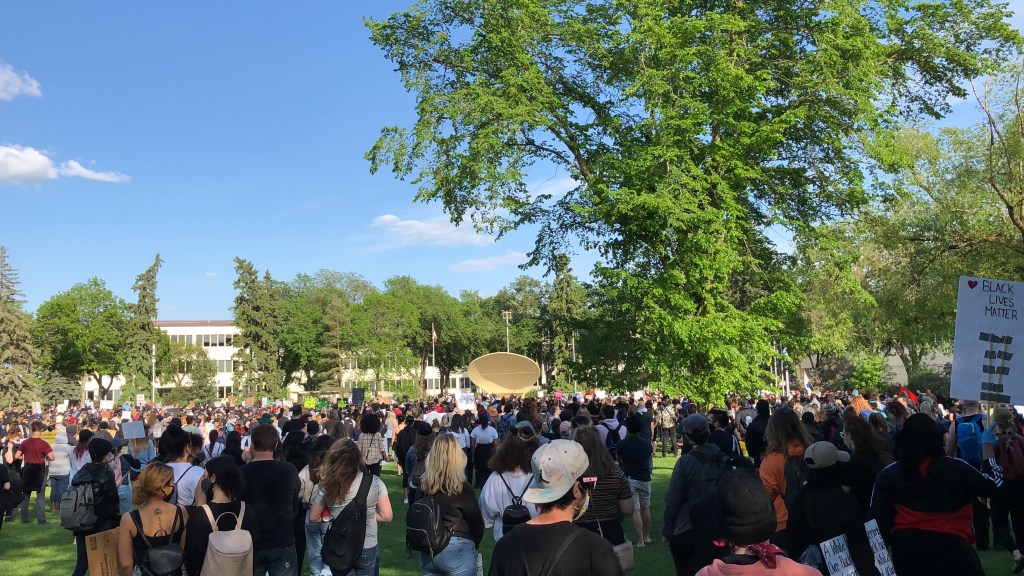
Last night Christina and I attended the Edmonton Black Lives Matter Rally. We heard pain, suffering, anguish, tribulation, and trouble (88) in the cries for justice and equality. We experienced all of these through the stories, testimonies, prayers, poems, and songs of people in pain. Sierra Jamerson moved us to tears as she shared her genealogical path of racism from the US South to Canada – where it did NOT improve. We bowed a knee with 15,000 Edmontonians and rested in silence with fists in the air. If you would have told me ten days ago that I would be at the Legislature with that many people – mask or no mask – I would have told you that you were crazy. But there was nowhere else we could have been last night – taking pandemic precautions to be in public and listening and reflecting on how our privilege relates to the suffering of others.

The theological problem of pain may find some resolution in Lewis’s book, but these racial manifestations are calls to action. God lacks neither power nor goodness but mysteriously allows us to be the manifestation of that power and goodness on Earth. We can end structural racism and systems that advantage some to the pain of others. Abandoning white privilege is a form of surrender that recognizes the operations of pain described above: all is not well, our current way of being is not sufficient, and we must humble ourselves in the same manner as Christ. The problem of racial pain in North America is a white one, and it is time we made the sacrifices necessary to address it. It is time to humble ourselves, listen, be obedient to what God is calling us to in this hour, and surrender.

In your relationships with one another, have the same mindset as Christ Jesus:
Who, being in very nature God,
did not consider equality with God something to be used to his own advantage;
rather, he made himself nothing
by taking the very nature of a servant,
being made in human likeness.
And being found in appearance as a man,
he humbled himself
by becoming obedient to death—
even death on a cross!
(Phil. 2:5-8)