The Problem of Pain

Pandemic Book Recommendation #19: The Problem of Pain, by C.S. Lewis

It has been quite a few weeks since I posted here, but like most things in this COVID world, it feels like months. For three weeks of this hiatus, I was teaching my annual Physical Geography class at King’s. The course is usually 50% outdoors and includes field trips to Jasper and Drumheller. This year’s COVID-19 edition was online – an entirely different experience! Early in the class, we had a good discussion on the age of the Earth. A theology student had some excellent follow-up questions that morphed into a conversation about evolution, the existence of a historical Adam, and The Fall. I pulled The Problem of Pain off my shelf to reference how C.S. Lewis managed to negotiate evolution and Genesis 1-3 way back in 1940. A few days ago, the volume was still by my recliner, and I got lost in it one afternoon, re-reading it cover to cover. It is a timely book for these days of ever-increasing pain.

I will leave the chapters on evolution and Adam alone, but for a more contemporary view of this checkout Richard Middleton’s lecture “Human Distinctiveness and the Origin of Evil.”

In this blog, amid the tremendous pain our world is experiencing, I want to focus on the idea of surrender as it relates to racial inequality. C.S. Lewis summarizes the problem of pain like this:

 “If God were good, He would wish to make His creatures perfectly happy, and if God were almighty, He would be able to do what he wished. But the creatures are not happy. Therefore, God lacks either goodness, or power, or both.” (16)

Lewis works his way through the free will theodicy and aspects of The Fall to wrestle with how pain, though not all of it, can be linked directly to human evil and free will. Lewis identifies some good that can come from the horror of pain, and this good is linked to a theology of surrender, which he extrapolates using three “operations” of pain. First, pain shatters the illusion that all is well (93). Second, pain shatters the illusion of self-sufficiency – that what we have in and of itself is good enough (96). Third, pain is necessary for us to fully act out self-surrender to God, using martyrdom as the ultimate example of following Christ (102).

Still, Lewis struggles to get past the idea that pain in every form sucks ass. Those are not entirely his words, but he does claim that if he knew any way of escaping pain, he would crawl through the sewers to find it (105) – so it is close. Pain is painful, but he also argues from classic Christian doctrine that suffering is what makes us everything we were meant to be – that tribulation is a necessary element in redemption (114). We crave security and a lack of suffering, but this settled happiness would teach us to rest our hearts in this world and oppose a return to God (116).

It has been twenty years since I read this book, but based upon my old scribbles in the margins, I have not learned much over this time. Like Lewis, I still prefer life without pain, adversity, trial, or tribulation. If I have learned anything in the last twenty years, though, it is the value of surrender – of being with God in the present and being OK with things as they are and not as I would like them to be (something I am much better at in theory than in practice). Contemplative prayer and mindfulness (Radical Acceptance) remind me of Lewis’s assertion that our highest activity is response, not initiative (44). This is love – not that we loved God, but that God loved us. We want to be nouns, but we are only adjectives (75).

There are times to radically accept our suffering, and in this, find the will of God. But there are other times when we are called to end the injustice and suffering of others. Blessed are the poor, says Jesus, but as His followers, we are tasked to help end poverty. It is this paradox that we find ourselves in today. Suffering has its place in helping us find submission in God’s will, but Lewis is clear (and I agree) that pain is not good in itself! “It would be a false view to suppose that the Christian understanding of suffering is incompatible with the strongest emphasis on our duty to leave the world better than we found it (114).”

For instance, the pain of my sisters and brothers of African and Indigenous descent will not find resolution through radical acceptance and surrender alone. No – the pain of a 500-year history of slavery, genocide and racism is deep, and we have hardly begun to scratch the surface of speaking the truth about this pain and suffering in North America. C.S. Lewis did not help us much here. He is a man of his times, and as you would expect for a Christian book written in 1940, he writes as a white man to other white men. It is time to listen to some other voices! (Though perhaps the world has not been as frightened, conflict-ridden, and painful since these words written in the advent of World War II.)  
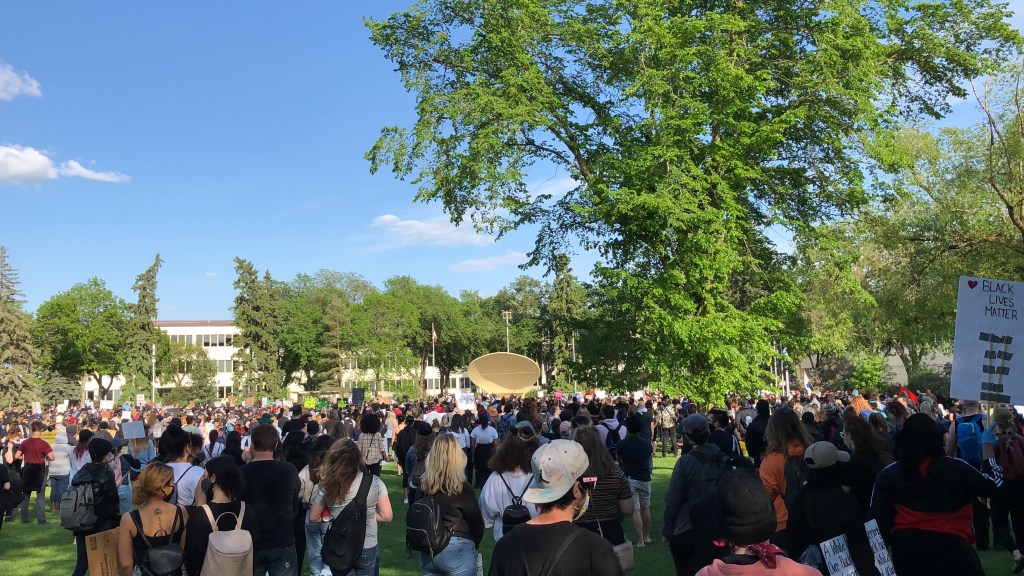
Black Lives Matter Rally, Edmonton. June 5, 2020

Last night Christina and I attended the Edmonton Black Lives Matter Rally. We heard pain, suffering, anguish, tribulation, and trouble (88) in the cries for justice and equality. We experienced all of these through the stories, testimonies, prayers, poems, and songs of people in pain. Sierra Jamerson moved us to tears as she shared her genealogical path of racism from the US South to Canada – where it did NOT improve. We bowed a knee with 15,000 Edmontonians and rested in silence with fists in the air. If you would have told me ten days ago that I would be at the Legislature with that many people – mask or no mask – I would have told you that you were crazy. But there was nowhere else we could have been last night – taking pandemic precautions to be in public and listening and reflecting on how our privilege relates to the suffering of others.

The theological problem of pain may find some resolution in Lewis’s book, but these racial manifestations are calls to action. God lacks neither power nor goodness but mysteriously allows us to be the manifestation of that power and goodness on Earth. We can end structural racism and systems that advantage some to the pain of others. Abandoning white privilege is a form of surrender that recognizes the operations of pain described above: all is not well, our current way of being is not sufficient, and we must humble ourselves in the same manner as Christ. The problem of racial pain in North America is a white one, and it is time we made the sacrifices necessary to address it. It is time to humble ourselves, listen, be obedient to what God is calling us to in this hour, and surrender.

In your relationships with one another, have the same mindset as Christ Jesus:
Who, being in very nature God,
did not consider equality with God something to be used to his own advantage;
rather, he made himself nothing
by taking the very nature of a servant,
being made in human likeness.
And being found in appearance as a man,
he humbled himself
by becoming obedient to death—
even death on a cross!
(Phil. 2:5-8)
In Betweens 1

In Betweens: Reflections from Annapurna. Chapter 1: Avalanche Field. April 26, 2019.

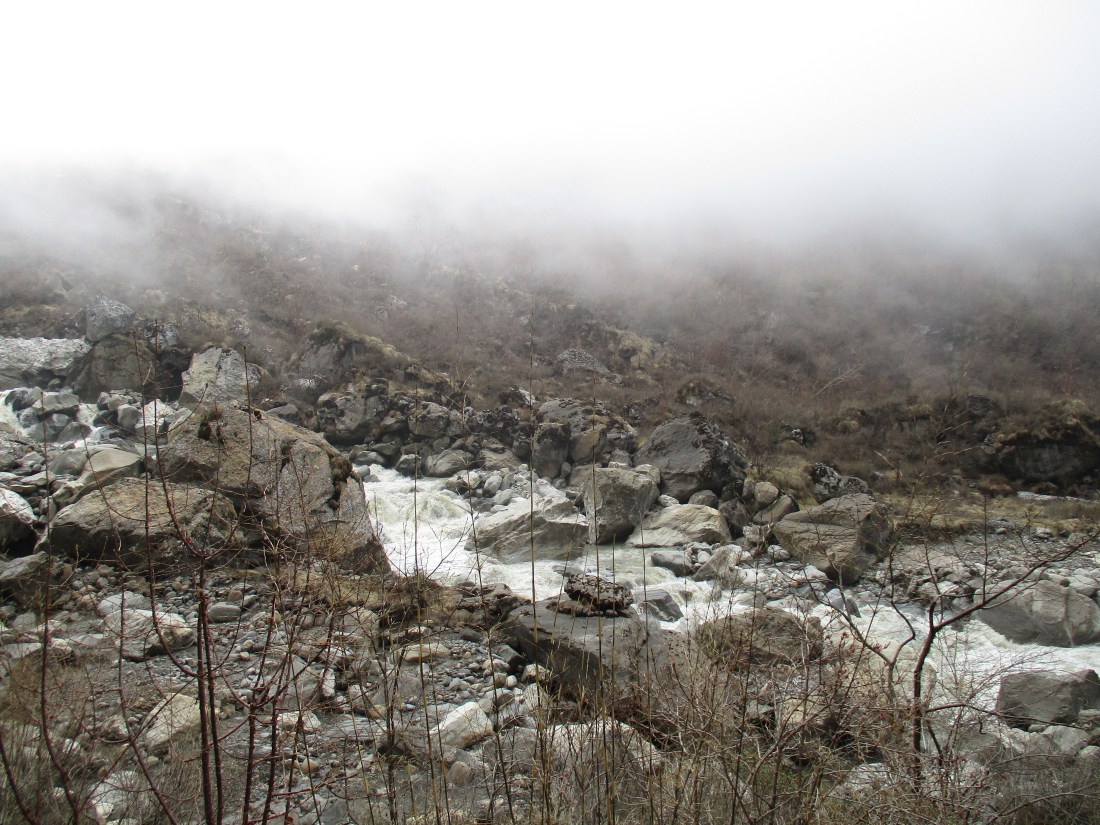
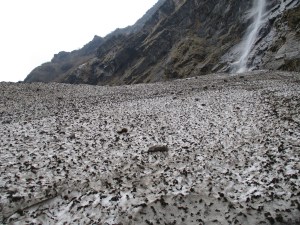
A waterfall cascades over wet rocks from imperceptible heights above, removing the spring glacial melt from the south side of Patal Hiunchuli mountain. I walk in a cloud, only able to see a few hundred metres all around. Across the valley, similar waterfalls flow from Machhapuchhre, the peak that has guided my way for over a week through the Annapurna region of the Himalaya mountains in Nepal. Their presence only makes them known through sound, though I saw them before the fog ascended. The snow beneath my feet is wet and melting with the spring heat, my boots and gators sinking a few centimetres with every step. Dirt, rocks and debris scattered across the voluminous heap arrived here within the last few months from landscapes up to three vertical kilometres above my head.

Waterfall, Patal Hiunchuli Avalanche Field

I have been rapidly descending from Machhapuchhre Base Camp (MBC) on day nine of my first trek to the Himalayan mountains. A half-hour ago, my path crossed into the melting snow of an avalanche field. I traversed a few of these on the way up yesterday, and I consider how it looks vaguely familiar as I begin to navigate my way across the now indiscernible path. At first, there were signs of previous human travel, but now all footsteps have disappeared. I gave my crampons away to a struggling French couple a few hours ago, so my traction is reduced. But, I’ve walked through enough snow in Canada that I’m not overly concerned about it. What’s the worst that could happen?

I quickly find a large rock just a few metres beyond the trail, and from this solid ground attempt to discern the best way forward through the fog and snow. The waterfall that was ahead of me to my right is now behind me, though I never crossed a stream. I may have already gone over the flow beneath the snow and debris, or it could be carving out a cavity beneath me in this very location. The slope is a relatively steep pitch, and below me, to the left, the sacred Modi Khola river is also rushing under the snow somewhere in the valley beneath. I don’t want to meander too low, or I could inadvertently fall through the melting snow into the river. But above me, the waterfall is draining into and under the snowfield.

I do my best to choose a wise path and decide to ere on the side of caution by going higher toward the waterfall. The snowpack is much taller in the middle, and I cannot see beyond twenty metres ahead of me as I climb. I walk slowly and carefully, taking great care with every step, gradually ascending the hill of ice without falling into the valley to my left by firmly planting my trekking poles with each step. It is slick, and I am regretting the loss of my crampons.

Eventually, I ascend the centre of the avalanche field to find another 200 metres of melting snow in front of me. I don’t recall anything like this on the way up, but perhaps I was simply too tired to notice. Today had been a tough slog from MBC at 3:00 am this morning to above Annapurna Base Camp (ABC), where I watched the sunrise from a rock perched high above the gathering pilgrims in what is called the Annapurna Sanctuary. I’ve trekked over a hundred kilometres in just a few days, which is a lot for a middle-aged chubby West Virginia born Canadian. I find myself to be very tired as I try to press forward.

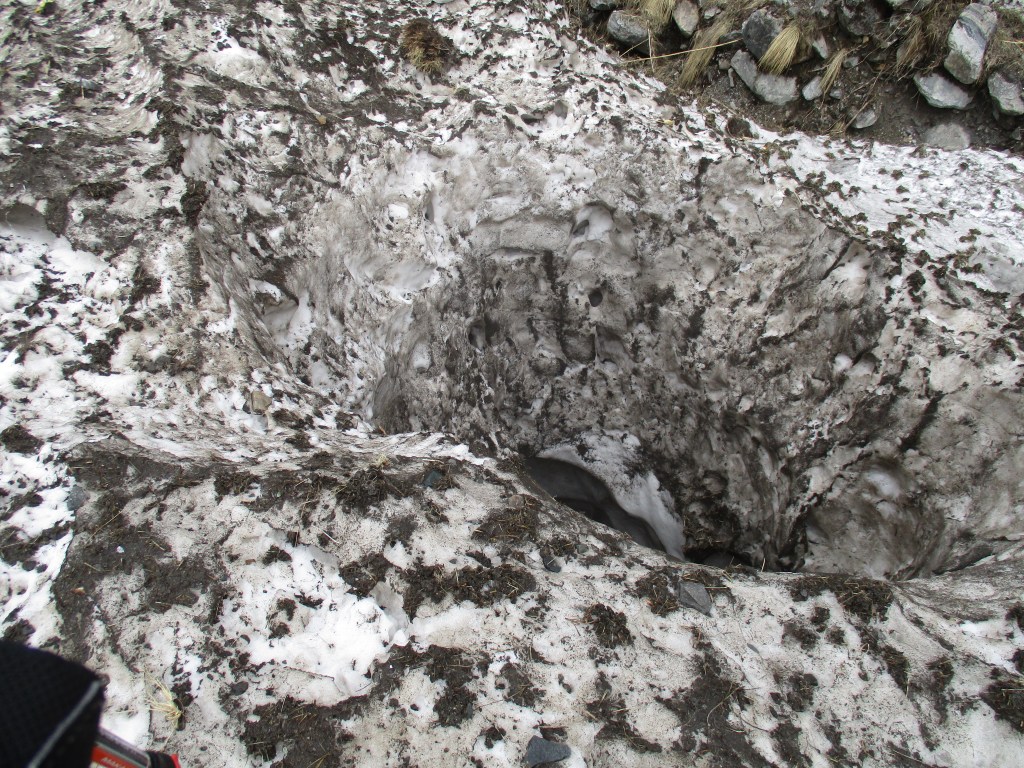
At the crest, I continue one step after another, and I soon notice to my right what appears to be a crevasse just above me. As this is not a glacier but a seasonal avalanche field, I am cognizant that as the hill of snow is melting, it is cracking, and it could easily fall in chunks to the river below. Gravity and the heat of spring will likely defeat this temporary formation in several weeks – if not today. I don’t want to be here for the more dramatic moments of this devolution. There is no snow on the cliffs above me, so I am not concerned about getting washed away in an avalanche, but perhaps I should be as the snowfall from the glacier of the 6441-metre mountain is also melting. But now my more significant concern lies to my left as falling into the valley sounds just as deadly and likely more painful. I’ve been walking solo for over an hour and have not seen anyone coming or going for most of that time. If I fall, I’m on my own. Perhaps I should have packed an ice axe as well?

As I continue, I pound my poles into the ground in front of me to ensure the snow is solid enough to hold. For twenty metres this works just fine, but then I hit a point where one pole sinks and I expose new mini crevasses in front of me. They are less than a metre deep, but it is not worth the risk to try to cross, so I double back and go a little lower on the hill, nearly slipping quite a few times. I make it past the crevasses, but again substantial melt is evident both above and below me, and cracks appear to be getting more significant as I get closer to the other side. The stream formed by the waterfall could be anywhere beneath me. In the summer, there is probably a clear path with a bridge crossing the creek, but predicting where that might lie is impossible. I’m 20 metres higher than either side of this tributary’s steep valley, and it is likely quite deep. The bridge may or may not exist under 50 metres of snow.

Crevasse in Avalanche Field above the Modi Khola

I take another step, and my probing pole breaks through. I listen as the snow that had been on the surface cascades down into a dark abyss at least a metre or two deep. I cannot go forward, so I backtrack again and try going even lower, continuing to test the path as I travel at a turtle’s pace. I lose track of time, unsure of how long I’ve been on the avalanche field. Step by step, I move up and down the slope more than I move laterally, but I make progress and find myself nearing the solid ground.

I can see where the path continues along a rising stone staircase, which is also mostly covered by avalanche debris and snow. It appears to me like a stairway to heaven, capable of carrying me away from my increasingly dangerous situation. But then I see the full extent of my predicament. As I continue to descend toward the edge, I note a gap at the end of the slope. Fifteen metres in front of the staircase, the avalanche field has collapsed, and there is no way to proceed without falling off a snow cliff of hidden depth. I could approach it to see if it is navigable, but likely it is undercut, and I would discover its height the hard way. The cliff spans up toward the waterfall behind me, but lower near the river, it appears to end. So, I sluggishly begin moving down the slope toward the river, imagining in my mind how it is likely rushing underneath the snow.

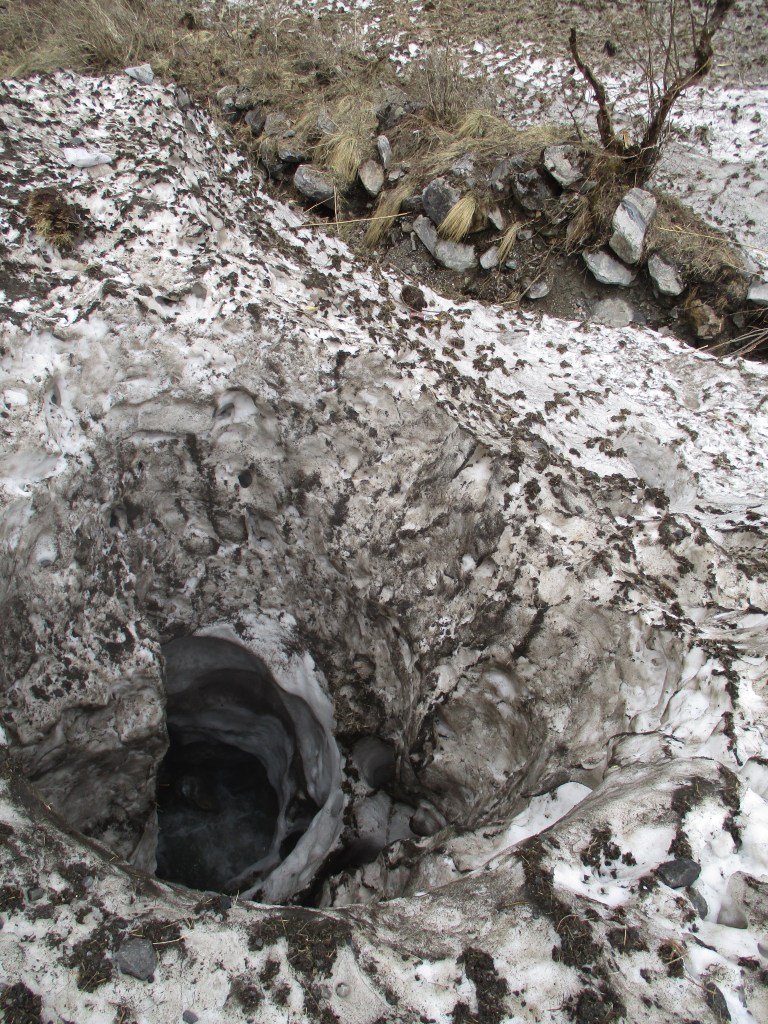
With only a few metres left, I begin to hear rushing water ahead and above to my right, and in a few more careful steps, I see the edge of a melt hole with a circumference of at least a metre. I’m only a few steps from it when I realize what it is, and I hold my camera out and take a picture to get a sense of its depth. When I look at my screen, my heart begins to race. It is at least 15 metres straight down to the cold, dark bottom. Another crevasse is to my left below me nearer to the river. I don’t see a way forward. But I am so close that backtracking is as unappetizing as proceeding.

I’m baffled that I have not seen anyone else since I started this crossing, and just as I am thinking this, two backpackers come from the other side down the stairs. They look across the avalanche field, see me stuck only 20 metres from them, assess their situation, and immediately turn around without saying a word.

I’m mystified that they might give up their trek to the base camps so easily. But then I realize they are not giving up. They are turning around to take a different route. The avalanche fields we crossed the day before were further downstream below the tea houses in Deurali. When I walked with my guide yesterday, he led us around this one, and suddenly the fog of my fatigue dissipates, and I remember seeing it from far above on the other side of the valley. I look across the river and up the mountain to see various coloured backpacks crossing either way on the winter trail that was created to avoid this very dilemma. I should have stuck with my guide today, I think to myself, as the full reality of my peril sets in with gravity. I’m stuck in between the melting crevasses behind me and the cliffs and melt holes before me.

My current predicament is illustrative of how I have been feeling in my life before this trek – lost and alone in the betwixt and betweens of my professional and personal journey. This trek to the Himalayas has been a kind of accidental pilgrimage, but one that has birthed insights to help find paths out of the challenges beleaguering me. Hopefully, the lessons I’ve learned will get me to the other side of this avalanche field, as well as into a more peaceful and present way of being back home.

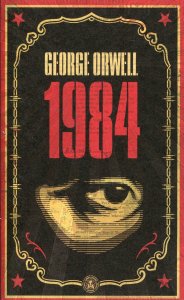
1984

Pandemic Book Recommendation #12: 1984 by George Orwell

I was not a disciplined student in High School, particularly in English Literature. Every time a new book was assigned, I would journey to the Meadowbrook Mall and snag the Cliff Notes from Walden Books (this was long before the days of Spark Notes). I’d follow the same pattern each time: memorize the characters, setting and general plot from the Cliff Notes and then talk to the girls in my class who actually read the book to get the spirit of the text for the essay. I could spend 1/20th of the time it would take to read the thing and still get a solid B+. It worked – and there are some books for which I still don’t regret this approach. I’ll likely never find the grit to make it through Anna Karenina – that assignment virtually destroyed what could have been a great love of reading. Perhaps I would like it now, but just hearing the title still brings back a form of adolescent literary PTSD. But now I do love reading, and those classics were assigned for a reason. For the last couple of decades, I’ve been picking up many of those old high school books I now wish I would have read in my youth. The timeliest of these for our present circumstances is 1984, written by George Orwell and published in 1949. I finally read it for real last summer and have thought about the book numerous times during this pandemic.

Just a few weeks ago George Conway (spouse of Kellyanne Conway, who is in Trump’s Administration) blasted Fox News for their about-face on the Coronavirus using an Orwellian Newspeak quote: “He accepted everything. The past was alterable. The past never had been altered. Oceania was at war with Eastasia. Oceania had always been at war with Eastasia.” Trump’s takeover of the coronavirus news conference yesterday had a similar spirit. We may already live in an age of Newspeak.

But perhaps the most interesting parallel between the world of the dystopian novel and our current reality involves surveillance. In the universe of the novel, there is no privacy. Telescreens in homes and hidden microphones in the wilderness ensure the thought police can see everything and enforce obedience to Big Brother. Yuval Harari recently penned an article titled “The World After Coronavirus” that unpacks the extraordinary ways surveillance has been advanced in the attempt to quell the virus (Youtube summary HERE). The surveillance already existing in our world today makes the technology in 1984 look pathetic. After the virus, will we live in a world of totalitarian surveillance and nationalist isolation, not that unlike the novel?

If you’re looking for something to read during the pandemic, it would be hard to find a more reasonable classic than 1984. You could try to slog your way through a Tolstoy novel – perhaps the 1,400+ pages of War and Peace? But why bother when 1984 is only 328 pages, and Orwell’s doublespeak will make you think differently about both war and peace: In Oceania, “War is peace. Freedom is slavery. Ignorance is strength.”

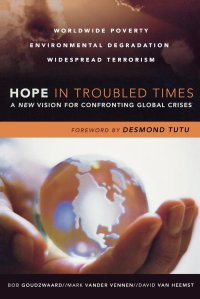
The bright morning star and the fruit tree: metaphors for hope in these troubled times

Pandemic Book Recommendation #9, Part 3: Hope

Part 2: Ideology

Part 1 Idolatry

Every day during this pandemic, I find it more difficult to see hope, especially when it comes to COVID-19’s spread across America. My oldest daughter is in Phoenix, and my family, including my parents, are spread across West Virginia and Kentucky. The slow daily crawl watching the case numbers climb is like a dawdling spiritual poison from a drug that takes weeks to finish its work.  Nonetheless, hope is always available if we are willing to seek it out. I’m trying. Bob Gouzwaard, Mark Vander Vennen and David Van Heemst remind us that hope is real because, “at its core, it is not a human creation. It attaches itself directly to the faith that God is deeply engaged in all of human history.” (172)

The conclusion of their book contains themes and metaphors of hope that apply to the tragic realities of pandemic. Some of their tropes are extraordinary and have consumed a few classes worth of past discussions in my courses. There is no space here for unpacking the circle and the cross (175), the periscope (181), the minesweeper (184), or the rope-ladder (187). Here I will only stick to two that seem most pertinent.

The Morning Star

There are beautiful signs of hope in the form of front-line health care workers sacrificing their own lives and safety to serve others – but even these stories exist in the context of tragedy. My Facebook feed is awash in the language of fear, blame and shock. When will this end? Where is God?

The authors of Hope in Troubled Times remind us that “Christian hope is a hope of contrast: it revives in the middle of the night, just when darkness seems to overpower us.” (176) They use the Biblical image of the morning star, which appears at the bleakest hours of the night, as a demonstration of the defeat of darkness. When the star appears, the morning is behind it. In the last words Jesus spoke to his disciples, he proclaimed, “I am… the bright morning star.” (Rev. 22:16)

The book of Esther in the Bible does not contain a mention of God. Yet, Esther’s name means “morning star.” She lived when the elimination of Israel appeared as fate. God seemed absent – but was there all along. “Miracles did not save Israel, at least not miracles as we understand them. But as a God who works hiddenly, God linked his saving acts to the act of Esther, who in obedience put her own life in jeopardy… When Esther is seen in the darkness of exile, that is the sign of daybreak. Where God in his hiddenness can be delineated, there is sign that the defeat of the night has come.” (177) Our front line health care workers are the Esthers of our day – the bright morning stars revealing the light that, though dim now, is soon to awaken the morning.

The Fruit Tree

I have suggested through the lens of this book that we are living in an age in which progress and material prosperity is the reigning ideology, perhaps to the point where economic growth has become an idol. This tragic pandemic can act as a catalyst for us to search our hearts about how we want to live in the coming post-COVID-19 world. The authors provide the fruit tree as a helpful metaphor in this regard.

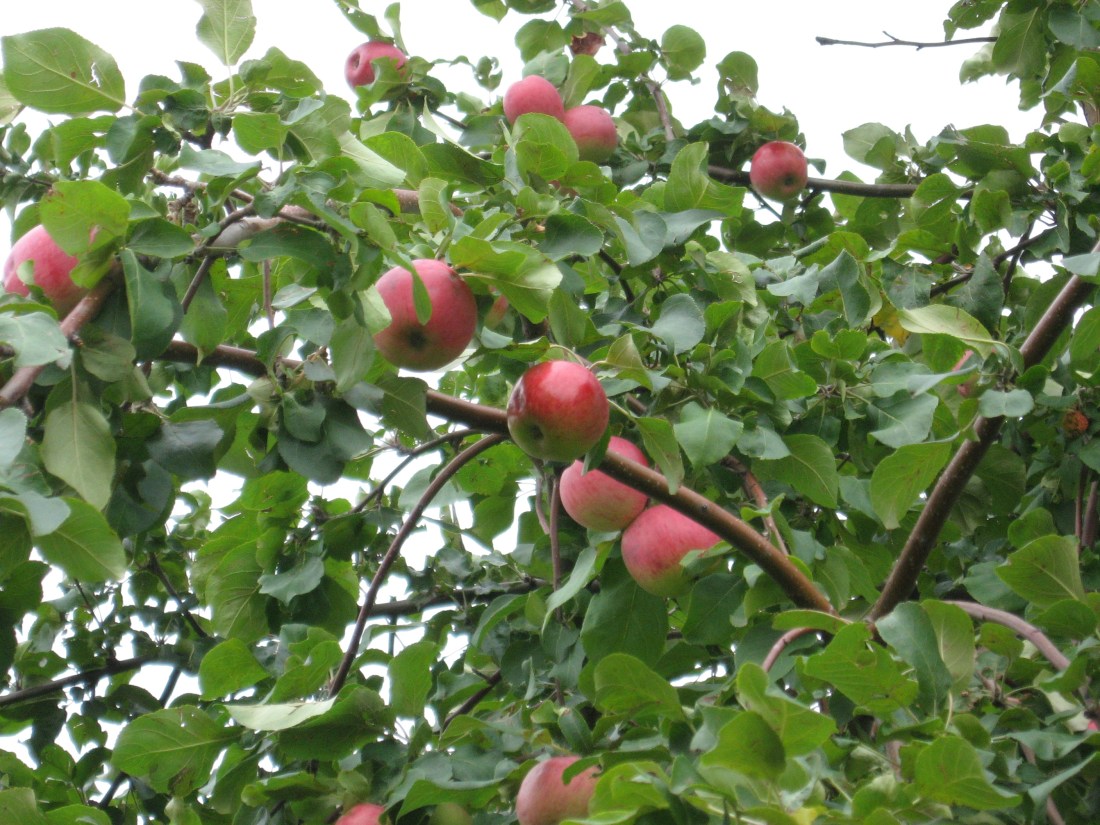
“No fruit tree is inclined to grow infinitely in height. If it did so, it would have to jettison all of its inefficient cells. It would have to put greater pressure on the soil and forgo the production of fruit entirely. Instead, at a certain point a fruit tree exercises built-in wisdom to redirect its growth energies away from expansion in height and toward the production of fruit. It reaches a saturation point and recognizes it as such. This allows the tree to create room to build up reserves and then to redirect its growth energies toward the production of fruit.” (191)

Like fruit trees, our economies – at the scales of the household and the nation – were not intended to grow infinitely forever. Like trees, we arrive at saturation points in which we have a choice to re-orient our energies toward the production of fruit rather than infinite growth. The authors suggest we “take one decisive, perhaps painful, but also realistic step back from the economic goal that hypnotizes us.” On the other side of this pandemic, we can choose to develop a pre-care economy as opposed to a post-care economy. This would place care needs first rather than last on a list of priorities. We could turn away from simplistic material expansion and toward sustainable economies that build community, meet the needs of the poor, and invest in the preservation of culture and the environment. Perhaps one of our problems is that “we have failed to imagine that the world can operate in any other way.” (192)

Pandemic Book Recommendation #9: Hope in Troubled Times, Part 1: Idolatry

I started this blog as an attempt to stay mentally healthy and positive during a time of social distancing. Many others have used social media as a platform for humour in this time of trial, and I’ve enjoyed seeing and relating to the many Facebook memes involving homeschooling, cats and social distancing. It worked for a few days. But two days ago I “popped” watching events unfolding in my home country. The context involved the government abandoning the advice of health experts and reopening the US economy to jump-start economic growth.

In the late evening of March 23, I posted the following on Facebook, “What we saw today in President Trump’s speech reveals the true god America worships. What do you say about a society that is willing to offer human sacrifices to appease the invisible hand of the market so we can all go back to consumption at the malls and prosperity in the stock market? Sacrifice the creation to this god – of course! Sacrifice the poor – no problem! Now we also appear to be willing to sacrifice our parents and grandparents. When will we confess and repent?”

Needless to say, this post started a bit of a discussion – and not much of it was touchy-feely or positive. The statement encapsulates a breadth of literature that is worth considering in these difficult days of pandemic. So, I’m going to step away from the positive self-help books for a few days and try to be a bit more prophetic in this blog. No matter your religious persuasion (or the lack thereof), consider looking at the monumental decisions being made in the United States through the lens of idolatry.

In 2007 Bob Gouzwaard, Mark Vander Vennen and David Van Heemst wrote Hope for Troubled Times: A New Vision for Confronting Global Crises. The volume is as important today as it was a decade ago when I started using it in some of my courses. I’m not going to provide a full review of it here, but rather use the book as a lens to consider how our current reliance on progress and economic growth could be an idol, in the fashion of the gods our ancestors would have crafted from wood or stone. I’ll make subsequent posts linking this idolatry to ideology, and then discuss hope for moving forward.

To start, the authors do assert that nothing is inherently evil about the economy, money or the market (170). Nonetheless, like wood or clay, these things can be formed into an apparatus to be worshiped. They describe three steps through which idol worship unfolds. First, people objectify the god using material available in order to bring the god closer. The image acts as an access point or gateway to the divine. Then people venerate the idol by bringing it sacrifices. Finally, people gradually become “reshaped and transformed into the likeness of their gods” (40).

Idols have mouths, but cannot speak,
Eyes, but they cannot see;
They have ears, but cannot hear,
Noses, but they cannot smell;
They have hands, but cannot feel,
Feet, but they cannot walk;
Nor can they utter a sound with their throats.
Those who make them will be like them,
And so will all who put their trust in them. (Ps. 115:5-8)

The authors assert that fear is what drives the final step. The image of their god may remain opaque, but its representation becomes very real. “The power that people delegate to the idol is a power that both saves and destroys. As such, it instills deeper and deeper anxiety. The slightest misstep can trigger the wrath of the idol, a wrath that may bring people to ruin. Serving idols therefore always brings with it a form of hypnosis, a hypnotic narrowing of consciousness. People’s perception of reality shrinks into a matter of merely finding the right type of interaction with the idol. But by then the god has, to some extent, assumed control: it now largely charts its own autonomous course. When that occurs, fear becomes the chief characteristic of life, and the sense of betrayal is pervasive.” (41)

Today it is quite common to hear the market described using terminology usually reserved for the religious realm. This involves not only the market’s saving power but also the sacrifices needed to maintain it.

– “We must follow the dictates of the market.”
– “Only economic growth can save us.”
– “All groups in society need to make sacrifices for a better future.” (97)

We are hearing this very language right now in the debate to jump-start the economy at the expense of the lives of front line health care workers and seniors. These sound profoundly religious, and this is not accidental. “It hints at decisions made about ultimate meaning, done either openly or unconsciously, without which people do not see life as feasible. Imitation saviors still move among us, and we see them as entitled to demand sacrifices.” (98)

Goudzwaard et al. make a strong argument that in the west, we are now trapped inside the cocoon of a perspective that will only consider solutions in line with the way we define progress (25). We have become consumed and obsessed with reaching our goals regardless of the cost. They argue that this is idolatrous in the sense that we exalt our goals of endless progress and material prosperity as the very powers that will deliver us to this end. In this manner, we have become dependent on our creations. But at a cost!

“The gods never leave their makers alone. As soon as people put themselves in a position of dependence on their gods, invariably the moment comes when those things or forces gain the upper hand, when they begin to mold the lives and thoughts of their adherents. Humanly made things or forces begin to control their makers even to the point where they become powers of domination. Against them the human will weakens or even vanishes, while the initial goals tend to become bleak, obscured, or forgotten, building in the moment when the gods’ betrayal becomes transparent. But by then it could be too late.” (27)

These times call for serious introspection and reflection. The economy is a social construct. Have we crafted a god in the form of material prosperity? If so, are we truly willing to pay the price of tribute? Are we so obsessed with our individual net worth and our collective GDP that we are willing to make this level of sacrifice to jump-start the economy? The rest of the world is prioritizing the lives and wellbeing of citizens – the very things the market was originally intended to enhance. Will America offload its responsibilities to fellow citizens and allow a false god to dictate the horrible sacrifices required? If so, can we continue to claim that America is a Christian nation?

Coming Up:
Part 2: Ideology
Part 3: Hope in Troubled Times

Pandemic Book Recommendation #6: The Sacred Year

On Saturday I posted my first pandemic book recommendation on James K.A. Smith’s “You Are What You Love.” Today’s suggestion follows along in that same vein – ideas for developing healthy spiritual disciplines while we are already social distancing. By the way – Rev. Jonathan Crane (Rector of St. Augustine of Canterbury Anglican Church in Edmonton) saw my post and invited me to chat about it with him on his church’s podcast. Check it out!

In today’s recommendation, Mike Yankoski has provided a helpful guide for exploring traditional and modern spiritual disciplines. As an evangelical motivational speaker, the author became frustrated by the lack of depth in his own spiritual life and in his tradition. He opens with a painful example while on the road with other Christian motivational speakers. To remedy the shallowness he decided to spend an entire year researching and practicing a variety of disciplines, and so “The Sacred Year” recounts this adventure exploring depth in himself, God and others.

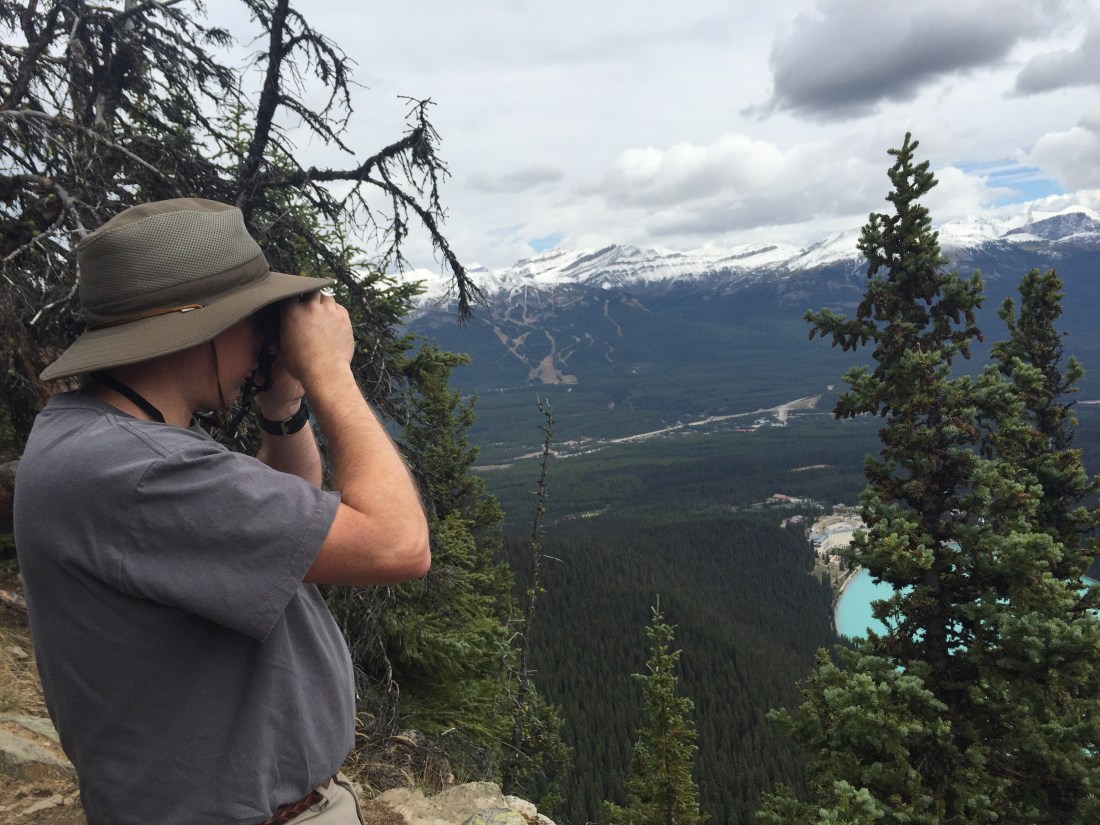
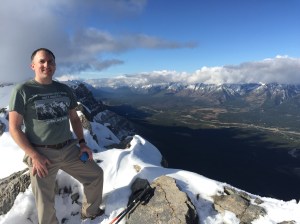
I “read” the book while hiking in the Canadian Rockies with my brother Andy in the Fall of 2017. As we summited Ha Ling over Canmore, reached Sentinel Pass above Larch Valley, and managed to top both of the Beehives then traverse the Valley of the Ten Glaciers above Lake Louise (all in three days) I listened to the entire book – twice! I’m an extrovert, so on these adventures I’m as social as can be in the mornings, evenings and during trail breaks. But, while hiking, I enjoy keeping to myself by listening to books, podcasts, or music (and yes – I do unplug and enjoy the sounds of nature as well). When I hike with Andy, going solo is out of necessity. He is five years younger, fifty pounds lighter, and a marathon runner. Thankfully he was patient enough to wait on me numerous times over the 110 km we hiked those three days.

Ha Ling above Canmore

Here are the disciplines I reflected on in that wilderness while “reading”: Attentiveness, Daily Examen, Sustenance, Simplicity, Creativity, Embracing Mortality, Confession, Listening Prayer, Lectio Divina, Regular Eucharist, Solitude, Sabbath, Wilderness, Pilgrimage, Gratitude, Protest, Pursuing Justice, Community, Caring.

I imagine many of us practice quite a few of these regularly, but now that we are social isolating for the pandemic, we have an extraordinary opportunity to dig a little deeper. Some of our households are already in need of a silent retreat! And though uncomfortable, who isn’t considering their mortality right now? Yankoski is a bit intense about some of these. For instance, he lives in a cave for a week to practice silence and digs a grave to practice embracing mortality. I’m writing this with two kids and a dog in my office – the cave sounds great! But you might start a panic in your neighbourhood if you start digging a grave out back – not recommended at this time.

Overall, this is a well written and helpful book. It recounts an evangelical’s experience as he rediscovers a depth of historic spiritual practice and brings others along for the ride. This is an excellent choice if you want to use your time of forced solitude to develop healthy habits and disciplines for other side of “the new normal.”

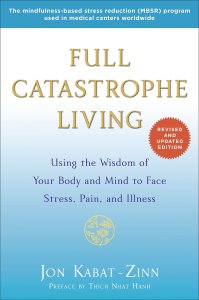
Ferber's Pandemic Book Recommendation #4 – Full Catastrophe Living by Jon Kabat-Zinn

(First published March 17, 2020 on Facebook)

Jon Kabat-Zinn’s classic book seems like an appropriate read right now based on the title alone. Does it not feel as though we are all already living the full catastrophe!? Kabat-Zinn is the founder of the Stress Reduction Clinic at the University of Massachusetts Medical Center. I discovered the 600+page tome when I tagged along with my wife Christina in an eight-week intensive MBSR (Mindfulness-Based Stress Reduction) training. It was quite a commitment as we had to practice mindful meditation for over an hour a day and participate in some intense group work every week. I went into it skeptical; I came out transformed.

The inspiration for the title comes from the 1964 film Zorba the Greek. When asked if he is married, Zorba (played by Anthony Quinn) responds, “Am I not a man? And is not a man stupid? I’m a man, so I’m married. Wife, children, house–everything. The full catastrophe.” Kabat-Zinn turns this on its head and spins it positive by offering resources for each of us to find control and calmness through relaxation, awareness, and the practice of being in the present. Thus, we become better equipped to be at peace in the “full catastrophe” – the spectrum of stress in life, which is unavoidable to all of us.

There is a reason my wife, a Psychologist, is interested in mindfulness. MBSR is rooted in many principles linked to cognitive behavioural therapy. Kabat-Zinn primarily works with individuals who have experienced medical dilemmas, but it is also valuable for other kinds of stressful circumstances that people cannot control (pandemic, anyone?). Through mindful meditation, we can find ways to reframe our circumstances and keep them in their proper place. By learning to listen to our bodies, we can grow in our capacity to “take on the full catastrophe” and deal with fear, panic, anxiety, and stress. We can learn to shift from an emphasis of “doing” to a focus on “being” – a timely skill for the coming weeks and months. Mindfulness helps us adjust to our suffering and walk more compassionately with others who are in physical or emotional pain.

Ferber’s Pandemic Book Recommendation #3 – The Gift of Fear by Gavin de Becker

(Originally posted March 16, 2020 on Facebook)

This book, first published in 1997, was written before Y2K, 911, or the conception of Gen Zs – let alone COVID-19. Yet, it remains a timely read for thinking about fear and our responses to it. Bonus: it is so old you can find free copies online (https://epdf.pub/gift-of-fear.html).

Gavin De Becker is the world’s expert on threat assessment. He was hired by countless movie stars and government officials to protect lives from stalkers and assassins. His book is full of harrowing real-life stories of people who were in danger when, either fear kicked in and they were able to find a way to survive, or they ignored their intuition to their own peril. The premise of his book, as captured in the title, is that fear is a gift and when it is respected it can save your life. But here is the kicker, and the reason the book is so relevant right now: We need to be able to differentiate between truly life-threatening situations and good old-fashioned worry.

I picked this book up last fall when I was still the Dean of Students at The King’s University. It interested me because, as a society, we seem to have forgotten how to differentiate the two. As DoS, I regularly worked with young adults who lived in a fragile emotional state of non-life-threatening fear. DeBecker asserts that what we truly fear is what we link to fear rather than what we think we fear. Read that last sentence twice then consider public speaking as an example. It’s not actually simple embarrassment that we fear. We don’t want to be perceived as incompetent, and this is linked to other fears such as not graduating or losing employment. This may be further linked to our identity – if we fail at public speaking then, perhaps, we could lose our very self! Our fears have a way of snowballing. When we realize what we really fear we can name it, and then work on changing our mindset up the chain of causality.

Back to COVID-19. Is it life threatening? Yes! But not to everyone equally. If you are reading this and you are an older adult your intuition should be telling you to isolate yourself or face a real statistical possibility of losing your life. If you are younger it is less likely that you will die from this pandemic, though evidence from China and Italy demonstrates there is a threat as some front-line workers in their 20s and 30s have died. In the case of real threats fear can help us make decisions to stay alive. As an older adult you may want to head to Lowes to work on a basement reno, and listening to the intuition in your gut that says this is a bad idea could be a life-saving decision. (No Dad, this example is not just a coincidence – please save the basement reno for fall!). For all of us there are plenty of other things to fear including loss of loved ones, loss of employment, loss of social interaction, running out of toilet paper, and on and on. If your life is in danger, listen to the gift fear is intuiting and isolate. If your fears are linked to something else please still isolate (for the sake of all our loved ones), but also consider naming your fears as this might help differentiate between fear as a gift and fear as worry. Knowing there are things we can do to make our situation better can alleviate both life-threatening fear and the worries associated with other fears. Washing your hands, practicing social isolation, looking out for your neighbors, and practicing self-care (praying, reading, meditating, exercising, etc.) are things we can do to get through these difficult weeks without finding ourselves locked in fear.

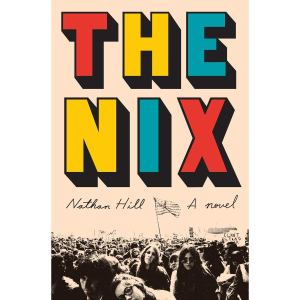
Ferber’s Pandemic Book Recommendation #2 – The Nix by Nathan Hill

(Originally posted March 15, 2020 on Facebook)

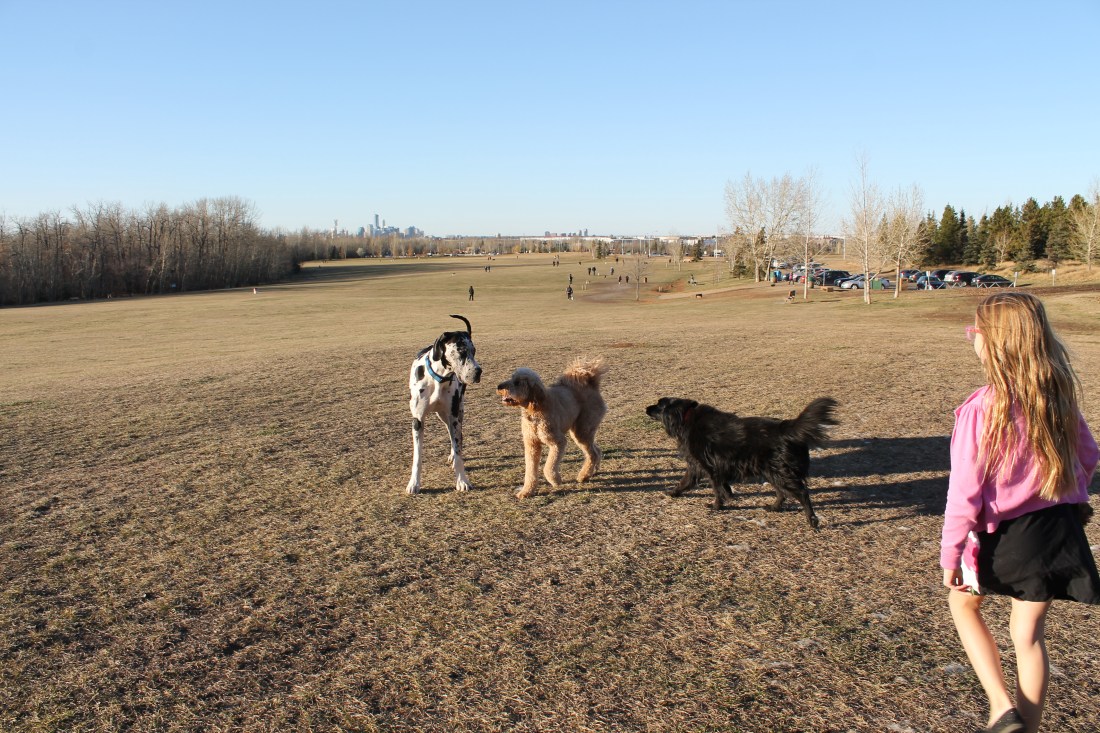
I finished The Nix a few weeks ago, and I miss it. It’s a 22 hour listen on Audible or a 600+ page read – perfect for avoiding Sabbatical writing or the constant barrage of pandemic news. The heartbreaking yet hysterical life of Community College English Professor Samuel Anderson-Andreson entertained me every day while Poppy and I journeyed through several of Edmonton’s dog parks. Frequently dog companions gave me side looks as I passed them literally laughing out loud. Poor Poppy was forced to walk countless extra kilometres when we would get back to the car, then suddenly take another lap because I couldn’t take off my headphones until I digested one more chapter.

Nathan Hill is an extraordinary master of satire who somehow manages to weave three different yet coherent stories of comedic tragedy into this intergenerational exploration of college life during the distinct eras of the Boomers, Gen X, and Millennials. My favourite scene involves Samuel’s struggle to address a plagiarized paper with Laura Pottsdam, a stereotypically entitled millennial student who manages to unconsciously utilize every conceivable logical fallacy in her attempt to avoid consequences. She eventually gets away with it when she convinces Samuel’s Dean that he caused her to experience “negative feelings of stress and vulnerability.” Samuel’s only escape – from his students, from the book he is supposed to be writing (and for which he already received an advance), from the pain of his mother abandoning him, and from the loss of the only girl he will ever love – is a video game called ElfScape. His best friends are people he has never met in the real world. But then his mom re-enters his life through the television via a ridonkulous political drama that plays out on the national American stage, and which engulfs him in a pilgrimage to understand his past. The story moves back and forth in time as the mysteries of Samuel’s genealogy illuminate his tragic life. Hill manages to weave a tapestry integrating themes like friendship, love, addiction, abandonment, loneliness, identity, vocation, female oppression, frozen food, war, and politics in settings as far-ranging as pre-World War II Norway, the 1968 Chicago Democratic Convention, post-911 Iraq, and the Occupy Wall Street movement.

The Nix is fitting pandemic reading because Hill has a way of illustrating the paradoxes of our contemporary world through the developing eyes of childhood, young adulthood, middle age, and senility. As we social distance for the sake of our parents and grandparents, this novel may be a helpful lens to consider what is truly important in life – and what is not.

Ferber’s Pandemic Book Recommendation #1 – You Are What You Love by James K.A. Smith

(Originally posted on FaceBook March 14)

I read WAY too much – usually two or three books a week. I have at least three or four volumes lying around different rooms of my house, and whenever I’m exercising or taking Poppy to the dog park I bring along my headphones and listen to authors on Audible. These last two months while on Sabbatical I’ve been an especially prolific reader – an escape from my primary task of writing. Since we’re all now social distancing, I thought I’d start posting recommendations. I don’t plan to write book reviews, but I’ll mention reasons I think a volume is timely and interesting.

My day #1 pick is You Are What You Love by James K. A. Smith. I thought of this book yesterday when Christina and I went out to buy a few necessities at the Grocery Store (Noodle Bowls for Brendan, Mac & Cheese for Tessa, Coffee Creamer for Wayne & Dorothy, and Cinnamon Buns – the necessities of apocalyptic living). I was aware of the panic shopping happening in the States but was naïve to its presence in Edmonton. Toilet paper? Really? Standing in a completely bare aisle reminded me of Smith’s concept of cultural liturgies. Our hearts are like a compass and our habits can reveal our deepest desires, including the idols we may not even realize we “worship” through the liturgies (daily habits) of our lives. Consumption tops Smith’s list – he argues that as a society we tend to find meaning and purpose in our shopping and consumption. What does the fascinating and ridiculous toilet paper panic of 2020 tell us about ourselves? What does it mean that when we are afraid, we go shopping? Check out Smith’s book and see if there are some provoking questions and ancient answers.

I wrote a slightly longer review on this one for student development professionals here:

https://www.thecacsd.org/blog/you-are-what-you-love-by-james-ka-smith-book-review-by-michael-ferber