Playing God

Pandemic Book Recommendation #15: Playing God: Redeeming the Gift of Power by Andy Crouch

I took a day off yesterday and did not post, but if I were to have provided a book recommendation on Easter, it would have been Playing God by Andy Crouch.

One of the reasons I love this book is that Andy has channelled Jayakumar Christian as a model. Jayakumar is a World Vision practitioner in India who works with the lowest castes in some of the most impoverished contexts in Asia. I was exposed to Jayakumar through his published Master’s thesis, God of the Empty-Handed, when I worked for World Vision US Programs. I’ve used his ideas in many courses, especially the International Development and Sustainability class I teach each summer for the Au Sable Institute of Environmental Studies. God of the Empty-Handed is worthy of its own book recommendation down the road. But Playing God is an excellent introduction to Jayakumar’s ideas of power and powerlessness in the Kingdom of God. Jayakumar digs into how the powerful utilize god-complexes to play god in the lives of the poor by perpetuating their powerlessness through relational structures and systems of captivity. The examples may seem more evident for India’s caste system, but there are potent applications for North America as well. Andy Crouch spent time with Jayakumar, and Playing God was birthed from that inspiration, but written for use in the US and Canada.

Playing God investigates how power, when viewed through a Christian lens, is a gift – this is the volume’s central idea. Crouch is somewhat opposed to the bulk of writing in the social sciences that would define power as always about corruption and coercion (though we can find plenty examples of this, many unfortunately provided by the Christian Church). Power is intended to be about creation and restoration, and forms of power that coerce are diminishments and corruptions of true power. The intended purpose of power is flourishing. Crouch delineates how power corruptions are linked to idolatry and ideology, and he even includes a chapter on privilege. He draws upon Jayakumar’s work to consider solutions to today’s crises caused by god-playing. This is what makes the volume such a good read for the Easter season.

According to the ancient hymn captured in Philippians 2, though himself God, Christ emptied himself of himself to become human, take the nature of a servant, and die on the cross in the act of restoration. This is the great kenosis or self-emptying. Crouch calls us to either find ways of being icons and image-bearers of this kind of self-emptying power purposed toward flourishing, or suffering as idol makers corrupting power toward our own or our tribe’s advantage. And yes, for you lovers of the lectionary, I am aware that Philippians 2 is a Lenten passage. Nonetheless, it has powerful application in the Easter season as we seek to make our attitudes the same as that of Christ Jesus.

Playing God is a timely read in this moment of global pandemic as we think about the kind of world we want to create / recreate when we emerge from social distancing. There is a cacophony to recreate the world as it was before COVID-19; to jump-start the economy along with all of its structures and systems that keep some people in power and others in captivity. We can do better. Power is a gift because it is for flourishing – the flourishing of all people and the creation. “When power is used well, people and the whole cosmos come more alive to what they were meant to be.” (13) Perhaps it is time to abandon our image of GOP Jesus for the version we find in Scriptures such as Philippians 2?

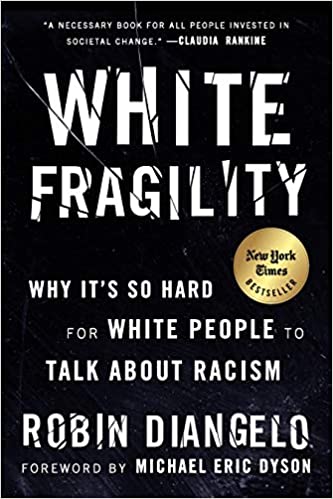
White Fragility

Pandemic Book Recommendation #13: White Fragility by Robin DiAngelo

Here is a book recommendation primarily for my white friends, and it is neither a comfortable nor easy read. This is especially true for my more left-leaning progressive white network – those of us who feel comfortable talking about race, have friends from many ethnicities, and generally see ourselves as part of the solution to injustices and disparities in the world. Robin DiAngelo is a white scholar with a Ph.D. in Multicultural Education from the University of Washington and a researcher in the field of Whiteness Studies. She argues that white progressives are the primary voices in America that are keeping the structures of racism in place. Yes – that said progressives, not neo-conservatives. The term she coined for why this is happening is “white fragility.”   

White fragility is the inability of white people to tolerate racial stress – a disbelieving defensiveness that whites exhibit when their ideas about race and racism are challenged. This is particularly the case when whites are implicated in white supremacy. For many whites, it is difficult to talk about racism whatsoever. Many of us would rather see ourselves as colour-blind. When the topic of race emerges, we may become overly sensitive, and in fact, DiAngelo’s research demonstrates that we often do. Her research establishes that we have a tendency toward weaponizing our hurt feelings and becoming defensive when confronted with racial inequality and injustice. “But I’m not a racist. I don’t say the N-word.” The mere suggestion of racism can cause more outrage among white people than the racism itself. “And if nobody is racist,” she asks, “why is racism still America’s biggest problem? What are white people afraid they will lose by listening? What is so threatening about humility on this topic?”

The original essay reflecting on these ideas was released in a paper in 2011. This book emerged after the term went viral, and it remained on the New York Times bestseller list for months. A central point of her argument is that being nice to people of colour is not enough. Whites hold institutional power in the structures of America, and this is arguably the case in Canada as well. In the western colonial context, racism is a system and not just a slur. It is prejudice plus power. The structures in place benefit whites over people of colour, and this can be demonstrated in just about every economic and social measurement.

The current pandemic is a case in point. Right now, today, more black and brown Americans are dying per capita than white Americans from COVID-19. Similar trends are occurring in Britain. This is being described as a crisis within a crisis, and the causes are relatively clear. Before the crisis, people of colour had a higher chronic disease burden and higher levels of obesity tied to racial health disparities linked to structural racism. Institutional biases exist in how people of colour are treated in care – this has been thoroughly researched and established. Additionally, because there are limited coronavirus tests available, the categories determined to administer a test put people of colour at a disadvantage. Not as many black or brown Americans have travelled abroad, nor do they know people who have. Entire communities lack access to testing. PBS ran a helpful segment on this earlier in the week.

The racially divided statistics of morbidity in this pandemic offer clear evidence that America has what DiAngelo describes as a “white supremacist culture.” And, BOOM – These kinds of statements are what tend to kick whites into our mode of defensiveness, as we picture radical neo-Nazis and want to be sure that everyone understands this is not us. “Now breathe,” she requests of her readers. “I am not saying that you are immoral. If you can remain open as I lay out my argument it should soon begin to make sense.” She asserts that racism is a white problem that was constructed and created by white people, and the ultimate responsibility lies with white people. “For too long we’ve looked at it as if it were someone else’s problem, as if it was created in a vacuum. I want to push against that narrative.”

DiAngelo provides steps for whites to reduce fragility and use racial discomfort as a mechanism to understand structural racism better. The book is eye-opening, especially for those who have not thought about structural racism and white privilege. It is a worthy and very timely lockdown read.

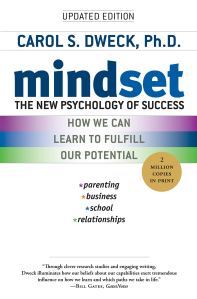
Mindset

Pandemic Book Recommendation #11: Mindset by Carol S. Dweck

Yesterday I recommended the book Grit and shared my definition of fortitude: grit plus a growth mindset. Today’s book recommendation is essentially part 2. Like Grit, Mindset is a popular recast of a lifetime of scholarship from Carol S. Dweck, Professor of Psychology at Stanford.  

Her premise is quite simple and not very earth-shattering when taken at surface level. For those who are “fixed,” it is transformative. People with a fixed mindset believe that abilities are just that. They are less likely to flourish than those with a growth mindset, who believe that skills can be developed. “I’m not smart enough,” or “I’m not good enough,” becomes the mantra of the fixed. This attitude can be found in just about any aspect of life from athletics to academics to parenting. Dweck argues that it is possible for people to decide they can accomplish that which seemed impossible – if they change their attitude.  Through determination and hard work, students can develop a love of learning and succeed, parents can figure out how to homeschool, and people who are in quarantine can, indeed, stay put.

The combined power of grit and a growth mindset can provide the fortitude necessary to persevere through this pandemic. We can remind ourselves that we can and will get through this, and we can find new ways every day to grow in the process.

What opportunities does this time of pandemic offer you to develop a growth mindset, and how can grit help you pursue them?

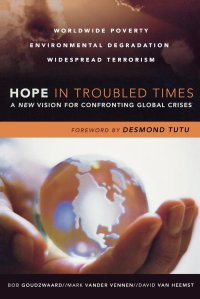
Hope in Troubled Times, Part 2: Ideology

My son Brendan and I are reading the book Collapse together while we are social distancing. (Look for a recommendation on this one down the road). His favourite chapter thus far has been about Easter Island, where the population used all the resources at their disposal in a tribal race to honour their ancestors through what Brendan calls Yum-Yum heads. Author Jared Diamond queries what the person who cut down the last tree might have been thinking. Likely they were so entrenched in the ideology of the time they were not cognizant of the consequences: starvation and the loss of 90% of the population. 

This post is part two in a longer than usual recommendation for the book Hope In Troubled Times by Bob Gouzwaard, Mark Vander Vennen and David Van Heemst. Yesterday I addressed idolatry through the lens of the book and recent opinions that the US should jump-start the economy by Easter. Today I’m looking at how this may reveal one of the dominant ideologies of our day.

In the volume, ideology is defined as “the entire set of conceptions and beliefs subscribed to by a specific group of people.” (32) It can also mean “a deliberate political attempt to systematically regulate or manipulate people’s currently held ideas in order to achieve certain societal ends.” (33) Ideology has three primary components:

  1. Absolutized political or societal end goals.
  2. A redefinition of currently held values, norms and ideas to such an extent that they legitimize in advance the practical pursuit of the predetermined end.
  3. Establishing a standard by which to select the means or instruments necessary for effectively achieving the all-important goal. (33)

The core idea is that within an ideology, the end goal becomes paramount, and anything getting in the way of that goal is ascribed as evil. The authors use the French Revolution, Nazism, and Communism as examples, demonstrating how each was crafted toward a non-negotiable end and had specific people or ideas that were considered evil. In Nazism, for example, the Jews were declared to be evil itself because they opposed the overarching end. (34)  The authors go into considerable detail on the phases of ideological development: conception, actualization, (re)construction, domination, terror, dissolution. (52-55) There is more on ideology than I’m going to describe here, which is why this is a book recommendation. Check it out!

Of interest today is one of the four ideologies that Goudzwaard et al. argue exist in our current era: “The pursuit of more material wealth or prosperity and the opportunity for continued material progress.” (38) To be fair, the authors are not entirely convinced material progress and prosperity are full-fledged ideologies in the same sense as Communism or Nazism. They call for caution. Nonetheless, they cite some interesting trends that point to the existence of an ideology, beginning with socioeconomic paradoxes that border on absurdities.

  1. The poverty paradox: “Despite an unprecedented expansion of wealth, recent years have witnessed unpredicted increases in situations of deepening poverty.” This is the case not only in developing nations but in the world’s richest countries. “If material prosperity expands in a country, then why has poverty not been alleviated in tandem with that expansion?” (87)
  2. The care paradox: “Opportunities for extending care are steadily eroding in increasingly wealthy societies.” We are seeing the realities of this right now in the pandemic. Countries like the US should be the most financially prepared for such a disaster. Clearly, this is not the case. (87)
  3. The time paradox: Prosperity should bring more free time for leisure and the enjoyment of wealth. However, at least before social distancing measures, our pace has accelerated, and the effects of stress and burnout are evident.
  4. The environment paradox: “The application of improved technologies, more economic resources, and a series of international agreements has not been able to turn the tide of environmental destruction.” (88)

The authors root these paradoxes within the tensions between dynamism and production – “the tension between what can progress and what can scarcely progress.” (90) Poverty results because many in society cannot keep up with the pace of change due to structural, educational, or economic factors. Care as an economic activity cannot keep up because the costs and prices of service increase proportionately faster than productive sectors. Society tends to view anything economically stationary as regressive. This means the only real response available to the care sector in this paradigm is to find ways to increase efficiencies, which means less staff and equipment (as continuously seen in the news this very day). Things are worse for the time paradox and environment paradox as these are impediments to increased productivity. These paradoxes cannot be solved by more money, technology or science precisely because they flow out of “the excess of the forces of unlimited development.” (91)

The ideological conclusion: “The spreading scourge of paradoxes in our society is a sign or signal that our society does not allow the negative and even risky consequences of paradoxes to overrule the belief that, above all, else, the current dynamism must be sustained and expanded.” (91) More succinctly, we live within an ideology of endless progress. The means of this progress are the economy, technology and science. The idea that we must keep progressing has become an absolute end that seems irrefutable to many. Progressives arguing for the preservation of the environment or social justice become evil opponents in this ideology. It is not surprising that we are willing to sacrifice 1 to 3% of the population in America if those individuals, who are not economically productive, put the ultimate end of the ideology at risk. The economy simply must grow, and we must become more prosperous. There is no alternative.

Tomorrow I’ll look at how the realization of and repentance from this ideology can lead to hope in these troubled times.