The Problem of Pain

Pandemic Book Recommendation #19: The Problem of Pain, by C.S. Lewis

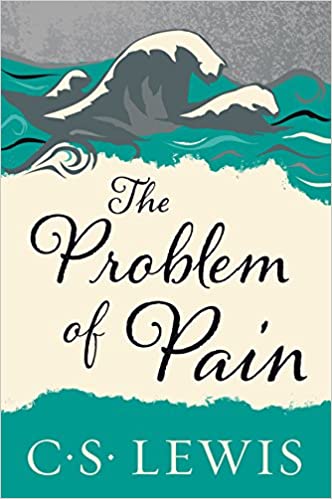
It has been quite a few weeks since I posted here, but like most things in this COVID world, it feels like months. For three weeks of this hiatus, I was teaching my annual Physical Geography class at King’s. The course is usually 50% outdoors and includes field trips to Jasper and Drumheller. This year’s COVID-19 edition was online – an entirely different experience! Early in the class, we had a good discussion on the age of the Earth. A theology student had some excellent follow-up questions that morphed into a conversation about evolution, the existence of a historical Adam, and The Fall. I pulled The Problem of Pain off my shelf to reference how C.S. Lewis managed to negotiate evolution and Genesis 1-3 way back in 1940. A few days ago, the volume was still by my recliner, and I got lost in it one afternoon, re-reading it cover to cover. It is a timely book for these days of ever-increasing pain.

I will leave the chapters on evolution and Adam alone, but for a more contemporary view of this checkout Richard Middleton’s lecture “Human Distinctiveness and the Origin of Evil.”

In this blog, amid the tremendous pain our world is experiencing, I want to focus on the idea of surrender as it relates to racial inequality. C.S. Lewis summarizes the problem of pain like this:

 “If God were good, He would wish to make His creatures perfectly happy, and if God were almighty, He would be able to do what he wished. But the creatures are not happy. Therefore, God lacks either goodness, or power, or both.” (16)

Lewis works his way through the free will theodicy and aspects of The Fall to wrestle with how pain, though not all of it, can be linked directly to human evil and free will. Lewis identifies some good that can come from the horror of pain, and this good is linked to a theology of surrender, which he extrapolates using three “operations” of pain. First, pain shatters the illusion that all is well (93). Second, pain shatters the illusion of self-sufficiency – that what we have in and of itself is good enough (96). Third, pain is necessary for us to fully act out self-surrender to God, using martyrdom as the ultimate example of following Christ (102).

Still, Lewis struggles to get past the idea that pain in every form sucks ass. Those are not entirely his words, but he does claim that if he knew any way of escaping pain, he would crawl through the sewers to find it (105) – so it is close. Pain is painful, but he also argues from classic Christian doctrine that suffering is what makes us everything we were meant to be – that tribulation is a necessary element in redemption (114). We crave security and a lack of suffering, but this settled happiness would teach us to rest our hearts in this world and oppose a return to God (116).

It has been twenty years since I read this book, but based upon my old scribbles in the margins, I have not learned much over this time. Like Lewis, I still prefer life without pain, adversity, trial, or tribulation. If I have learned anything in the last twenty years, though, it is the value of surrender – of being with God in the present and being OK with things as they are and not as I would like them to be (something I am much better at in theory than in practice). Contemplative prayer and mindfulness (Radical Acceptance) remind me of Lewis’s assertion that our highest activity is response, not initiative (44). This is love – not that we loved God, but that God loved us. We want to be nouns, but we are only adjectives (75).

There are times to radically accept our suffering, and in this, find the will of God. But there are other times when we are called to end the injustice and suffering of others. Blessed are the poor, says Jesus, but as His followers, we are tasked to help end poverty. It is this paradox that we find ourselves in today. Suffering has its place in helping us find submission in God’s will, but Lewis is clear (and I agree) that pain is not good in itself! “It would be a false view to suppose that the Christian understanding of suffering is incompatible with the strongest emphasis on our duty to leave the world better than we found it (114).”

For instance, the pain of my sisters and brothers of African and Indigenous descent will not find resolution through radical acceptance and surrender alone. No – the pain of a 500-year history of slavery, genocide and racism is deep, and we have hardly begun to scratch the surface of speaking the truth about this pain and suffering in North America. C.S. Lewis did not help us much here. He is a man of his times, and as you would expect for a Christian book written in 1940, he writes as a white man to other white men. It is time to listen to some other voices! (Though perhaps the world has not been as frightened, conflict-ridden, and painful since these words written in the advent of World War II.)  
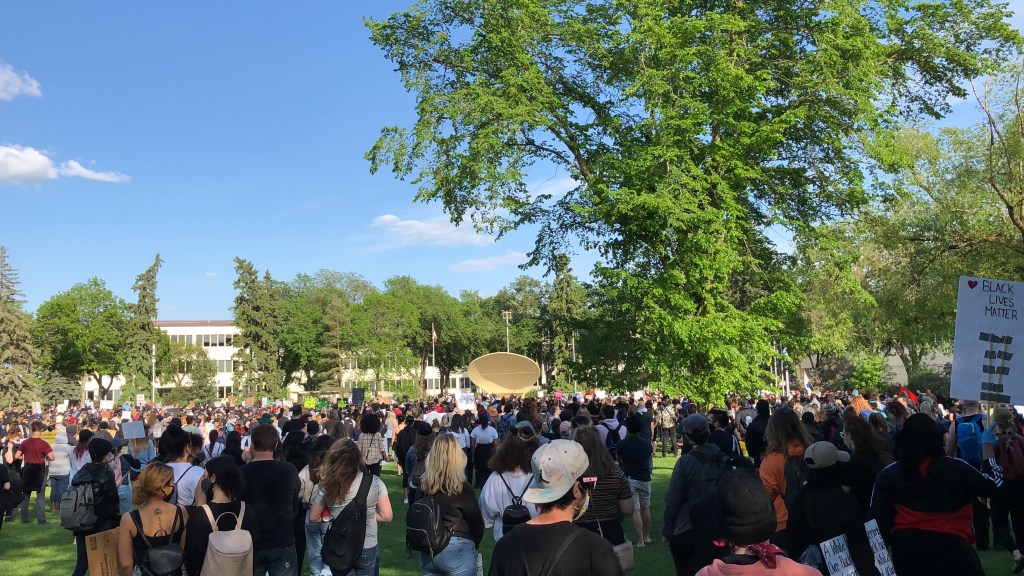
Black Lives Matter Rally, Edmonton. June 5, 2020

Last night Christina and I attended the Edmonton Black Lives Matter Rally. We heard pain, suffering, anguish, tribulation, and trouble (88) in the cries for justice and equality. We experienced all of these through the stories, testimonies, prayers, poems, and songs of people in pain. Sierra Jamerson moved us to tears as she shared her genealogical path of racism from the US South to Canada – where it did NOT improve. We bowed a knee with 15,000 Edmontonians and rested in silence with fists in the air. If you would have told me ten days ago that I would be at the Legislature with that many people – mask or no mask – I would have told you that you were crazy. But there was nowhere else we could have been last night – taking pandemic precautions to be in public and listening and reflecting on how our privilege relates to the suffering of others.

The theological problem of pain may find some resolution in Lewis’s book, but these racial manifestations are calls to action. God lacks neither power nor goodness but mysteriously allows us to be the manifestation of that power and goodness on Earth. We can end structural racism and systems that advantage some to the pain of others. Abandoning white privilege is a form of surrender that recognizes the operations of pain described above: all is not well, our current way of being is not sufficient, and we must humble ourselves in the same manner as Christ. The problem of racial pain in North America is a white one, and it is time we made the sacrifices necessary to address it. It is time to humble ourselves, listen, be obedient to what God is calling us to in this hour, and surrender.

In your relationships with one another, have the same mindset as Christ Jesus:
Who, being in very nature God,
did not consider equality with God something to be used to his own advantage;
rather, he made himself nothing
by taking the very nature of a servant,
being made in human likeness.
And being found in appearance as a man,
he humbled himself
by becoming obedient to death—
even death on a cross!
(Phil. 2:5-8)
Where the Crawdads Sing

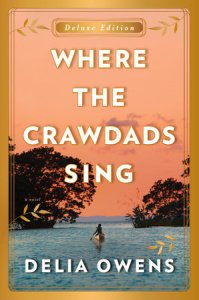
Pandemic Book Recommendation #18: Where the Crawdads Sing, by Delia Owens

Where the Crawdads Sing, by Delia Owens, is the perfect pandemic read – especially if you have been feeling lonely and isolated. It is the story of Kya Clark, who begins the book as six-year-old marsh trash along the racially charged North Carolina Coast. Her story is heart-wrenching, but her spirit of resiliency will make your efforts to get through quarantine feel like a walk in the park. This is a novel inspired by nature, as the marsh becomes Kya’s teacher and she ascends to a role as its most exceptional student and defender. It is the coming of age story of a girl you will come to love and admire, even as you suspect her of murder in the first degree. This a murder mystery after all, and the setting moves back and forth in time between 1952 when Kya’s tragic story begins unfolding and 1969, when Barkley Cove’s star quarterback was possibly killed late at night in a swamp tower.

There are three reasons I loved this book. First, Delia Owens has captured the spirit of Aldo Leopold in a setting I know and love. The North Carolina beach was our summer vacation refuge when we lived in West Virginia, only the landscape I knew was developed to the point that Kya would find unrecognizable. The deep complexity and connections between species were mostly forgotten, protected turtles being one of the few remaining vestiges of a once ecologically rich landscape. Owens cites Aldo Leopold’s A Sand County Almanac as the primary inspiration for her book, and his fingerprints are on almost every page. When a young man – a Marine Biologist in training – begins teaching Kya to read, he starts her with the first sentence of A Sand County Almanac: “There are some who can live without wild things, and some who cannot.” Kya’s reaction: “I did not know a sentence could be so full.” Kya takes Leopold’s vision to heart and lives it out in the novel. “Aldo Leopold taught her that floodplains are living extensions of the rivers, which will claim them back any time they choose. Anyone living on a floodplain is just waiting in the river’s wings.” She had no patience for those who sought to drain the “wasteland” of the swamp. “Large machines cutting oaks. Diggin channels to dry the marsh. Leaving tracks of thirst. They had not read Aldo Leopold.” The nature imagery throughout the volume is a welcome respite amid social distancing measures. A Northern Flicker feather even makes an appearance – our favourite bird at our backyard feeder here in Edmonton.

Second, this is a book about loneliness, and 2020 has been the loneliest year of my highly extroverted life. Kya’s reflections of her years of near-total isolation spoke to me in ways I was not expecting. Owens describes how loneliness became, for Kya, a natural appendage. Her life is one defined by rejections, and the lonely becomes more than she can hold as she seeks to protect herself in the marsh. “The rarest of shells, splendid sunsets, could not stop it.” She cries, “I have to do life alone. But I knew this. I’ve known a long time that people don’t stay.” She laments, “Please don’t talk to me about isolation. No one has to tell me how it changes a person. I have lived it. I am isolation.” Strong words in this age of pandemic. Kya can be our teacher and guide, only her isolation may or may not have led to a murder scene – so choose your lessons wisely.

The third thing I loved about this book was the poetry. I’m not usually a big fan, and honestly, I can’t distinguish between good and bad poems. But the timing of some of the passages was profound during my reading of the book. I listened to it on Audible during long walks in the evening, and one night, as I was along the North Saskatchewan River at sunset, I put the following poem on repeat:

“Sunsets are never simple.
Twilight is refracted and reflected,
but never true.
Even tide is a disguise,
covering tracks, covering lies.
We don’t care that dusk deceives.
We see brilliant colors,
and never learn that the sun
has dropped beneath the Earth,
by the time we see the burn.”

Edmonton Sunset. April 8, 2020.

Where the Crawdads Sing is a story of loss, love, loneliness, discrimination, survival, connection, and murder. It captures the complexity of natural ecosystems and uses it as a lens to dissect human culture. We may be the dominant species on our planet, but we are mammals – and sometimes we act like them. “We still store those instincts in our genes, and they express themselves when certain circumstances prevail. Some parts of us will always be what we were. What we had to be to survive way back yonder.”

The bright morning star and the fruit tree: metaphors for hope in these troubled times

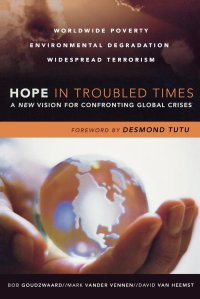
Pandemic Book Recommendation #9, Part 3: Hope

Part 2: Ideology

Part 1 Idolatry

Every day during this pandemic, I find it more difficult to see hope, especially when it comes to COVID-19’s spread across America. My oldest daughter is in Phoenix, and my family, including my parents, are spread across West Virginia and Kentucky. The slow daily crawl watching the case numbers climb is like a dawdling spiritual poison from a drug that takes weeks to finish its work.  Nonetheless, hope is always available if we are willing to seek it out. I’m trying. Bob Gouzwaard, Mark Vander Vennen and David Van Heemst remind us that hope is real because, “at its core, it is not a human creation. It attaches itself directly to the faith that God is deeply engaged in all of human history.” (172)

The conclusion of their book contains themes and metaphors of hope that apply to the tragic realities of pandemic. Some of their tropes are extraordinary and have consumed a few classes worth of past discussions in my courses. There is no space here for unpacking the circle and the cross (175), the periscope (181), the minesweeper (184), or the rope-ladder (187). Here I will only stick to two that seem most pertinent.

The Morning Star

There are beautiful signs of hope in the form of front-line health care workers sacrificing their own lives and safety to serve others – but even these stories exist in the context of tragedy. My Facebook feed is awash in the language of fear, blame and shock. When will this end? Where is God?

The authors of Hope in Troubled Times remind us that “Christian hope is a hope of contrast: it revives in the middle of the night, just when darkness seems to overpower us.” (176) They use the Biblical image of the morning star, which appears at the bleakest hours of the night, as a demonstration of the defeat of darkness. When the star appears, the morning is behind it. In the last words Jesus spoke to his disciples, he proclaimed, “I am… the bright morning star.” (Rev. 22:16)

The book of Esther in the Bible does not contain a mention of God. Yet, Esther’s name means “morning star.” She lived when the elimination of Israel appeared as fate. God seemed absent – but was there all along. “Miracles did not save Israel, at least not miracles as we understand them. But as a God who works hiddenly, God linked his saving acts to the act of Esther, who in obedience put her own life in jeopardy… When Esther is seen in the darkness of exile, that is the sign of daybreak. Where God in his hiddenness can be delineated, there is sign that the defeat of the night has come.” (177) Our front line health care workers are the Esthers of our day – the bright morning stars revealing the light that, though dim now, is soon to awaken the morning.

The Fruit Tree

I have suggested through the lens of this book that we are living in an age in which progress and material prosperity is the reigning ideology, perhaps to the point where economic growth has become an idol. This tragic pandemic can act as a catalyst for us to search our hearts about how we want to live in the coming post-COVID-19 world. The authors provide the fruit tree as a helpful metaphor in this regard.

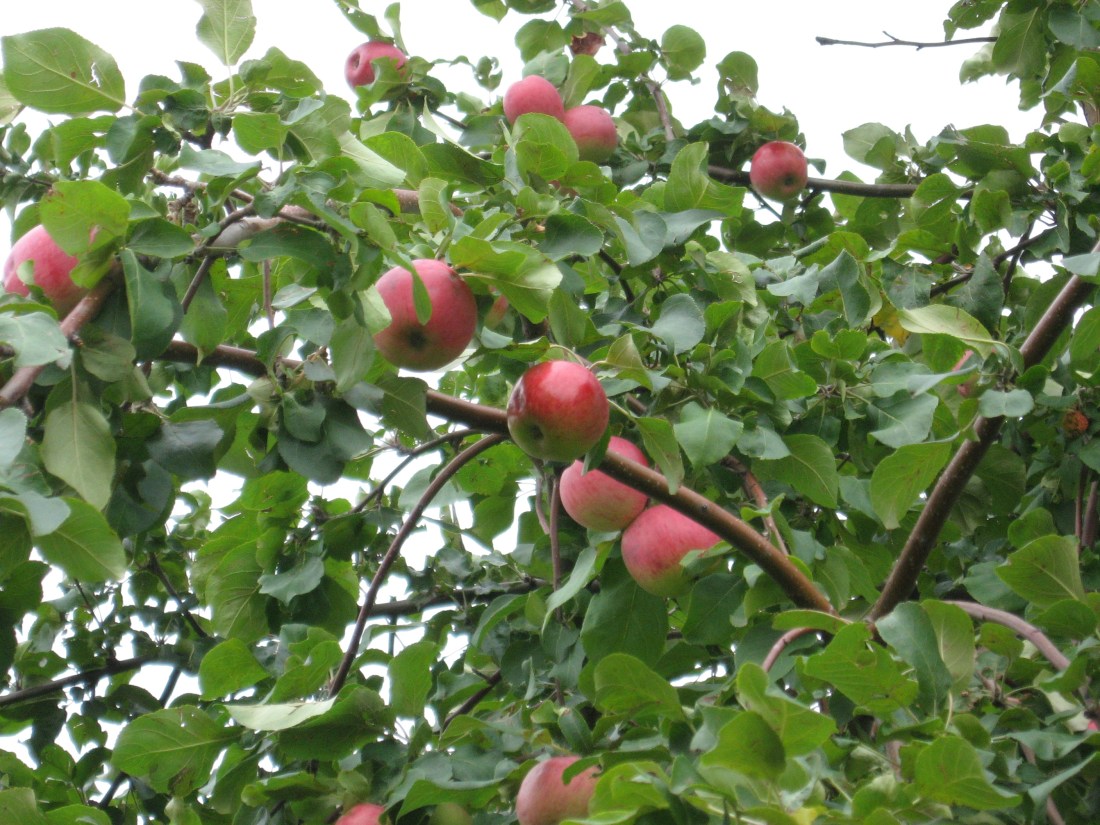
“No fruit tree is inclined to grow infinitely in height. If it did so, it would have to jettison all of its inefficient cells. It would have to put greater pressure on the soil and forgo the production of fruit entirely. Instead, at a certain point a fruit tree exercises built-in wisdom to redirect its growth energies away from expansion in height and toward the production of fruit. It reaches a saturation point and recognizes it as such. This allows the tree to create room to build up reserves and then to redirect its growth energies toward the production of fruit.” (191)

Like fruit trees, our economies – at the scales of the household and the nation – were not intended to grow infinitely forever. Like trees, we arrive at saturation points in which we have a choice to re-orient our energies toward the production of fruit rather than infinite growth. The authors suggest we “take one decisive, perhaps painful, but also realistic step back from the economic goal that hypnotizes us.” On the other side of this pandemic, we can choose to develop a pre-care economy as opposed to a post-care economy. This would place care needs first rather than last on a list of priorities. We could turn away from simplistic material expansion and toward sustainable economies that build community, meet the needs of the poor, and invest in the preservation of culture and the environment. Perhaps one of our problems is that “we have failed to imagine that the world can operate in any other way.” (192)

Ferber’s Pandemic Book Recommendation #3 – The Gift of Fear by Gavin de Becker

(Originally posted March 16, 2020 on Facebook)

This book, first published in 1997, was written before Y2K, 911, or the conception of Gen Zs – let alone COVID-19. Yet, it remains a timely read for thinking about fear and our responses to it. Bonus: it is so old you can find free copies online (https://epdf.pub/gift-of-fear.html).

Gavin De Becker is the world’s expert on threat assessment. He was hired by countless movie stars and government officials to protect lives from stalkers and assassins. His book is full of harrowing real-life stories of people who were in danger when, either fear kicked in and they were able to find a way to survive, or they ignored their intuition to their own peril. The premise of his book, as captured in the title, is that fear is a gift and when it is respected it can save your life. But here is the kicker, and the reason the book is so relevant right now: We need to be able to differentiate between truly life-threatening situations and good old-fashioned worry.

I picked this book up last fall when I was still the Dean of Students at The King’s University. It interested me because, as a society, we seem to have forgotten how to differentiate the two. As DoS, I regularly worked with young adults who lived in a fragile emotional state of non-life-threatening fear. DeBecker asserts that what we truly fear is what we link to fear rather than what we think we fear. Read that last sentence twice then consider public speaking as an example. It’s not actually simple embarrassment that we fear. We don’t want to be perceived as incompetent, and this is linked to other fears such as not graduating or losing employment. This may be further linked to our identity – if we fail at public speaking then, perhaps, we could lose our very self! Our fears have a way of snowballing. When we realize what we really fear we can name it, and then work on changing our mindset up the chain of causality.

Back to COVID-19. Is it life threatening? Yes! But not to everyone equally. If you are reading this and you are an older adult your intuition should be telling you to isolate yourself or face a real statistical possibility of losing your life. If you are younger it is less likely that you will die from this pandemic, though evidence from China and Italy demonstrates there is a threat as some front-line workers in their 20s and 30s have died. In the case of real threats fear can help us make decisions to stay alive. As an older adult you may want to head to Lowes to work on a basement reno, and listening to the intuition in your gut that says this is a bad idea could be a life-saving decision. (No Dad, this example is not just a coincidence – please save the basement reno for fall!). For all of us there are plenty of other things to fear including loss of loved ones, loss of employment, loss of social interaction, running out of toilet paper, and on and on. If your life is in danger, listen to the gift fear is intuiting and isolate. If your fears are linked to something else please still isolate (for the sake of all our loved ones), but also consider naming your fears as this might help differentiate between fear as a gift and fear as worry. Knowing there are things we can do to make our situation better can alleviate both life-threatening fear and the worries associated with other fears. Washing your hands, practicing social isolation, looking out for your neighbors, and practicing self-care (praying, reading, meditating, exercising, etc.) are things we can do to get through these difficult weeks without finding ourselves locked in fear.