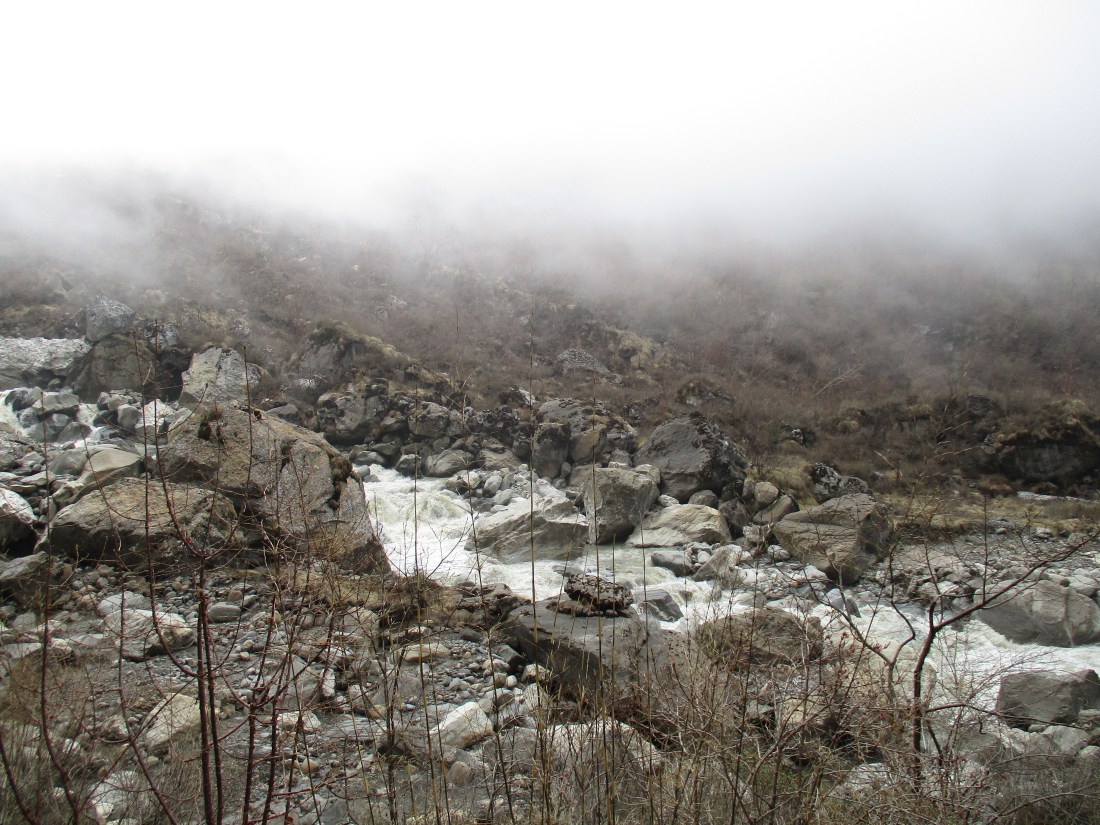
In Betweens 1

In Betweens: Reflections from Annapurna. Chapter 1: Avalanche Field. April 26, 2019.

A waterfall cascades over wet rocks from imperceptible heights above, removing the spring glacial melt from the south side of Patal Hiunchuli mountain. I walk in a cloud, only able to see a few hundred metres all around. Across the valley, similar waterfalls flow from Machhapuchhre, the peak that has guided my way for over a week through the Annapurna region of the Himalaya mountains in Nepal. Their presence only makes them known through sound, though I saw them before the fog ascended. The snow beneath my feet is wet and melting with the spring heat, my boots and gators sinking a few centimetres with every step. Dirt, rocks and debris scattered across the voluminous heap arrived here within the last few months from landscapes up to three vertical kilometres above my head.
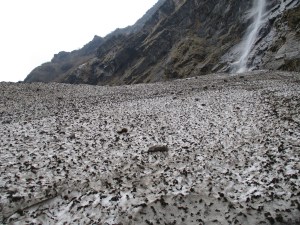
Waterfall, Patal Hiunchuli Avalanche Field

I have been rapidly descending from Machhapuchhre Base Camp (MBC) on day nine of my first trek to the Himalayan mountains. A half-hour ago, my path crossed into the melting snow of an avalanche field. I traversed a few of these on the way up yesterday, and I consider how it looks vaguely familiar as I begin to navigate my way across the now indiscernible path. At first, there were signs of previous human travel, but now all footsteps have disappeared. I gave my crampons away to a struggling French couple a few hours ago, so my traction is reduced. But, I’ve walked through enough snow in Canada that I’m not overly concerned about it. What’s the worst that could happen?

I quickly find a large rock just a few metres beyond the trail, and from this solid ground attempt to discern the best way forward through the fog and snow. The waterfall that was ahead of me to my right is now behind me, though I never crossed a stream. I may have already gone over the flow beneath the snow and debris, or it could be carving out a cavity beneath me in this very location. The slope is a relatively steep pitch, and below me, to the left, the sacred Modi Khola river is also rushing under the snow somewhere in the valley beneath. I don’t want to meander too low, or I could inadvertently fall through the melting snow into the river. But above me, the waterfall is draining into and under the snowfield.

I do my best to choose a wise path and decide to ere on the side of caution by going higher toward the waterfall. The snowpack is much taller in the middle, and I cannot see beyond twenty metres ahead of me as I climb. I walk slowly and carefully, taking great care with every step, gradually ascending the hill of ice without falling into the valley to my left by firmly planting my trekking poles with each step. It is slick, and I am regretting the loss of my crampons.

Eventually, I ascend the centre of the avalanche field to find another 200 metres of melting snow in front of me. I don’t recall anything like this on the way up, but perhaps I was simply too tired to notice. Today had been a tough slog from MBC at 3:00 am this morning to above Annapurna Base Camp (ABC), where I watched the sunrise from a rock perched high above the gathering pilgrims in what is called the Annapurna Sanctuary. I’ve trekked over a hundred kilometres in just a few days, which is a lot for a middle-aged chubby West Virginia born Canadian. I find myself to be very tired as I try to press forward.

At the crest, I continue one step after another, and I soon notice to my right what appears to be a crevasse just above me. As this is not a glacier but a seasonal avalanche field, I am cognizant that as the hill of snow is melting, it is cracking, and it could easily fall in chunks to the river below. Gravity and the heat of spring will likely defeat this temporary formation in several weeks – if not today. I don’t want to be here for the more dramatic moments of this devolution. There is no snow on the cliffs above me, so I am not concerned about getting washed away in an avalanche, but perhaps I should be as the snowfall from the glacier of the 6441-metre mountain is also melting. But now my more significant concern lies to my left as falling into the valley sounds just as deadly and likely more painful. I’ve been walking solo for over an hour and have not seen anyone coming or going for most of that time. If I fall, I’m on my own. Perhaps I should have packed an ice axe as well?

As I continue, I pound my poles into the ground in front of me to ensure the snow is solid enough to hold. For twenty metres this works just fine, but then I hit a point where one pole sinks and I expose new mini crevasses in front of me. They are less than a metre deep, but it is not worth the risk to try to cross, so I double back and go a little lower on the hill, nearly slipping quite a few times. I make it past the crevasses, but again substantial melt is evident both above and below me, and cracks appear to be getting more significant as I get closer to the other side. The stream formed by the waterfall could be anywhere beneath me. In the summer, there is probably a clear path with a bridge crossing the creek, but predicting where that might lie is impossible. I’m 20 metres higher than either side of this tributary’s steep valley, and it is likely quite deep. The bridge may or may not exist under 50 metres of snow.

Crevasse in Avalanche Field above the Modi Khola

I take another step, and my probing pole breaks through. I listen as the snow that had been on the surface cascades down into a dark abyss at least a metre or two deep. I cannot go forward, so I backtrack again and try going even lower, continuing to test the path as I travel at a turtle’s pace. I lose track of time, unsure of how long I’ve been on the avalanche field. Step by step, I move up and down the slope more than I move laterally, but I make progress and find myself nearing the solid ground.

I can see where the path continues along a rising stone staircase, which is also mostly covered by avalanche debris and snow. It appears to me like a stairway to heaven, capable of carrying me away from my increasingly dangerous situation. But then I see the full extent of my predicament. As I continue to descend toward the edge, I note a gap at the end of the slope. Fifteen metres in front of the staircase, the avalanche field has collapsed, and there is no way to proceed without falling off a snow cliff of hidden depth. I could approach it to see if it is navigable, but likely it is undercut, and I would discover its height the hard way. The cliff spans up toward the waterfall behind me, but lower near the river, it appears to end. So, I sluggishly begin moving down the slope toward the river, imagining in my mind how it is likely rushing underneath the snow.

With only a few metres left, I begin to hear rushing water ahead and above to my right, and in a few more careful steps, I see the edge of a melt hole with a circumference of at least a metre. I’m only a few steps from it when I realize what it is, and I hold my camera out and take a picture to get a sense of its depth. When I look at my screen, my heart begins to race. It is at least 15 metres straight down to the cold, dark bottom. Another crevasse is to my left below me nearer to the river. I don’t see a way forward. But I am so close that backtracking is as unappetizing as proceeding.
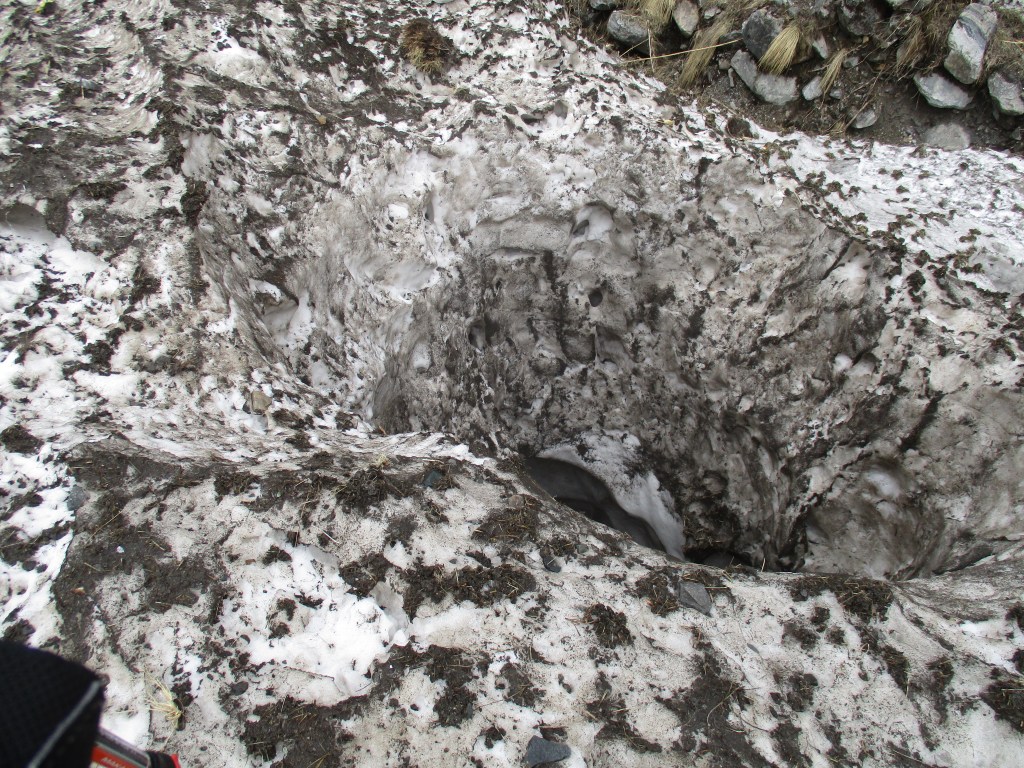
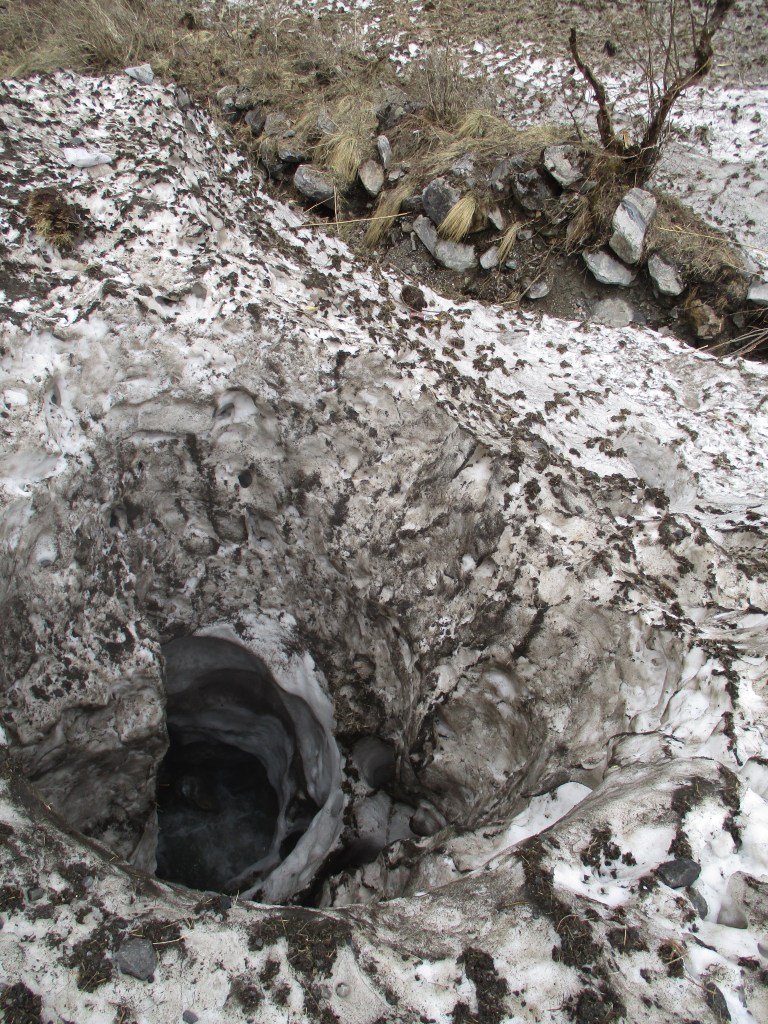
I’m baffled that I have not seen anyone else since I started this crossing, and just as I am thinking this, two backpackers come from the other side down the stairs. They look across the avalanche field, see me stuck only 20 metres from them, assess their situation, and immediately turn around without saying a word.

I’m mystified that they might give up their trek to the base camps so easily. But then I realize they are not giving up. They are turning around to take a different route. The avalanche fields we crossed the day before were further downstream below the tea houses in Deurali. When I walked with my guide yesterday, he led us around this one, and suddenly the fog of my fatigue dissipates, and I remember seeing it from far above on the other side of the valley. I look across the river and up the mountain to see various coloured backpacks crossing either way on the winter trail that was created to avoid this very dilemma. I should have stuck with my guide today, I think to myself, as the full reality of my peril sets in with gravity. I’m stuck in between the melting crevasses behind me and the cliffs and melt holes before me.

My current predicament is illustrative of how I have been feeling in my life before this trek – lost and alone in the betwixt and betweens of my professional and personal journey. This trek to the Himalayas has been a kind of accidental pilgrimage, but one that has birthed insights to help find paths out of the challenges beleaguering me. Hopefully, the lessons I’ve learned will get me to the other side of this avalanche field, as well as into a more peaceful and present way of being back home.
Pandemic Book Recommendation #8: Radical Acceptance

I had a difficult December and January this year, with an unexpected change in my job position right before Christmas due to budget restructuring. This was before Christina’s job was eliminated due to the AB budget changes in health care and a global pandemic roared its ugly head. Tara Brach’s “Radical Acceptance: Embracing Your Life with the Heart of a Buddha” has been one of the most helpful books inspiring me to live into saying “Yes” to an ever-evolving future. And no, I am not a Buddhist – this book has a lot to offer to everyone.

I listened to this on Audible after it was recommended to me by (surprise!) my wife, Christina. Tara Brach is a Clinical Psychologist and the founder of the Insight Meditation Community. She became a helpful mentor as I listened to her book at the gym while on the treadmill or elliptical. (Remember when we could go to the gym? Sigh…).

What is Radical Acceptance? Tara defines it as, “Clearly recognizing what is happening inside us, and regarding what we see with an open, kind and loving heart.” Radical Acceptance is about leaning into the present moment to observe our experience clearly, and be compassionate to ourselves about that experience. Radical Acceptance involves the practice of mindfulness. Jon Kabat-Zinn, whom I discussed last week, teaches a form of mindfulness stripped of religion. Though I am neither a Buddhist nor a philosophical idealist, I have tremendous respect for the practice of mindfulness, which is reflected in some ancient Christian traditions such as contemplative prayer.

I believe three of Tara’s practices, in particular, are helpful during this time of pandemic:

First, the power of a pause: taking time to stop and remember where we are, what we are doing, and why we think it matters. All of our patterns are changing as we step into the “new normal” of social distancing and, perhaps at times, full social isolation.  The pause helps us to be present in these changes and find opportunities for peace and gratitude.

Second, an essential question: What would it be like if we could accept life at this moment exactly as it is? What if I (you?) stopped thinking about how this moment could be better? If only there were sports. Or more seriously, if only I could work another shift to pay rent.  What if we stopped resisting our reality and instead open ourselves to the joy, freedom, and possibility that is right here in this moment? No matter how dire our situation, we can find acceptance and, therefore, peace – radical acceptance.

Finally, Smiling. Seriously. Our world needs more smiles right now. Tara defines a smile as the, “unconditional friendliness that welcomes experience without fear.” You could change the world of those around you this day with a smile.

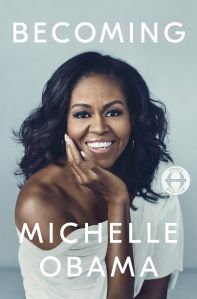
Pandemic Book Recommendation #5 – Becoming by Michelle Obama

(First published March 18, 2020 on Facebook)

This is just a quick one today. Yesterday Facebook sent me two notices that I broke the community standards by sending out Spam. They specifically referenced my book recommendations for Full Catastrophe Living and The Nix. What is funny is that they sent me a copy of the community standards and their aim to create a space for expression and give people a voice to build community and bring the world together. But that is what I was trying to do! ??? I think what happened is that I started each post with the same verbatim line and then provided links to a corporate website (amazon). My guess is a bot picked it up and flagged it as Spam. Otherwise, someone actually reported it as Spam, which would be kind of sad because I am recommending books to read to stay sane during a pandemic. One of you must really hate books!!! Either way, I’m not going to give up. I’m in the process of creating a WordPress blog site for these so Zuckerberg keeps his hands off them. If you can no longer see those posts they will be on the blog soon. But for now, here is my day #5 recommendation!

“Becoming,” by Michelle Obama, is the best autobiography I read this year. I have a ton of conservative friends whom I love and value, and I especially hope some of you will take the time to read Michelle’s story. You may discover Michelle is not the monster you have heard about in the media. She does not hate America and, believe it or not; she was not even very enthusiastic about Barrack running for office. Here is my challenge to my conservative friends: you read this and then message me a book you’d like me to read. When we’re both finished, we can have a Zoom conversation about the books and discover some things we have in common.

Ferber’s Pandemic Book Recommendation #3 – The Gift of Fear by Gavin de Becker

(Originally posted March 16, 2020 on Facebook)

This book, first published in 1997, was written before Y2K, 911, or the conception of Gen Zs – let alone COVID-19. Yet, it remains a timely read for thinking about fear and our responses to it. Bonus: it is so old you can find free copies online (https://epdf.pub/gift-of-fear.html).

Gavin De Becker is the world’s expert on threat assessment. He was hired by countless movie stars and government officials to protect lives from stalkers and assassins. His book is full of harrowing real-life stories of people who were in danger when, either fear kicked in and they were able to find a way to survive, or they ignored their intuition to their own peril. The premise of his book, as captured in the title, is that fear is a gift and when it is respected it can save your life. But here is the kicker, and the reason the book is so relevant right now: We need to be able to differentiate between truly life-threatening situations and good old-fashioned worry.

I picked this book up last fall when I was still the Dean of Students at The King’s University. It interested me because, as a society, we seem to have forgotten how to differentiate the two. As DoS, I regularly worked with young adults who lived in a fragile emotional state of non-life-threatening fear. DeBecker asserts that what we truly fear is what we link to fear rather than what we think we fear. Read that last sentence twice then consider public speaking as an example. It’s not actually simple embarrassment that we fear. We don’t want to be perceived as incompetent, and this is linked to other fears such as not graduating or losing employment. This may be further linked to our identity – if we fail at public speaking then, perhaps, we could lose our very self! Our fears have a way of snowballing. When we realize what we really fear we can name it, and then work on changing our mindset up the chain of causality.

Back to COVID-19. Is it life threatening? Yes! But not to everyone equally. If you are reading this and you are an older adult your intuition should be telling you to isolate yourself or face a real statistical possibility of losing your life. If you are younger it is less likely that you will die from this pandemic, though evidence from China and Italy demonstrates there is a threat as some front-line workers in their 20s and 30s have died. In the case of real threats fear can help us make decisions to stay alive. As an older adult you may want to head to Lowes to work on a basement reno, and listening to the intuition in your gut that says this is a bad idea could be a life-saving decision. (No Dad, this example is not just a coincidence – please save the basement reno for fall!). For all of us there are plenty of other things to fear including loss of loved ones, loss of employment, loss of social interaction, running out of toilet paper, and on and on. If your life is in danger, listen to the gift fear is intuiting and isolate. If your fears are linked to something else please still isolate (for the sake of all our loved ones), but also consider naming your fears as this might help differentiate between fear as a gift and fear as worry. Knowing there are things we can do to make our situation better can alleviate both life-threatening fear and the worries associated with other fears. Washing your hands, practicing social isolation, looking out for your neighbors, and practicing self-care (praying, reading, meditating, exercising, etc.) are things we can do to get through these difficult weeks without finding ourselves locked in fear.

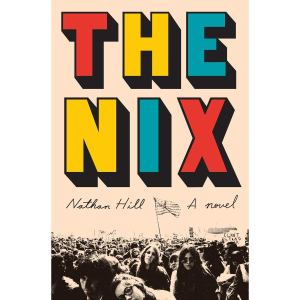
Ferber’s Pandemic Book Recommendation #2 – The Nix by Nathan Hill

(Originally posted March 15, 2020 on Facebook)

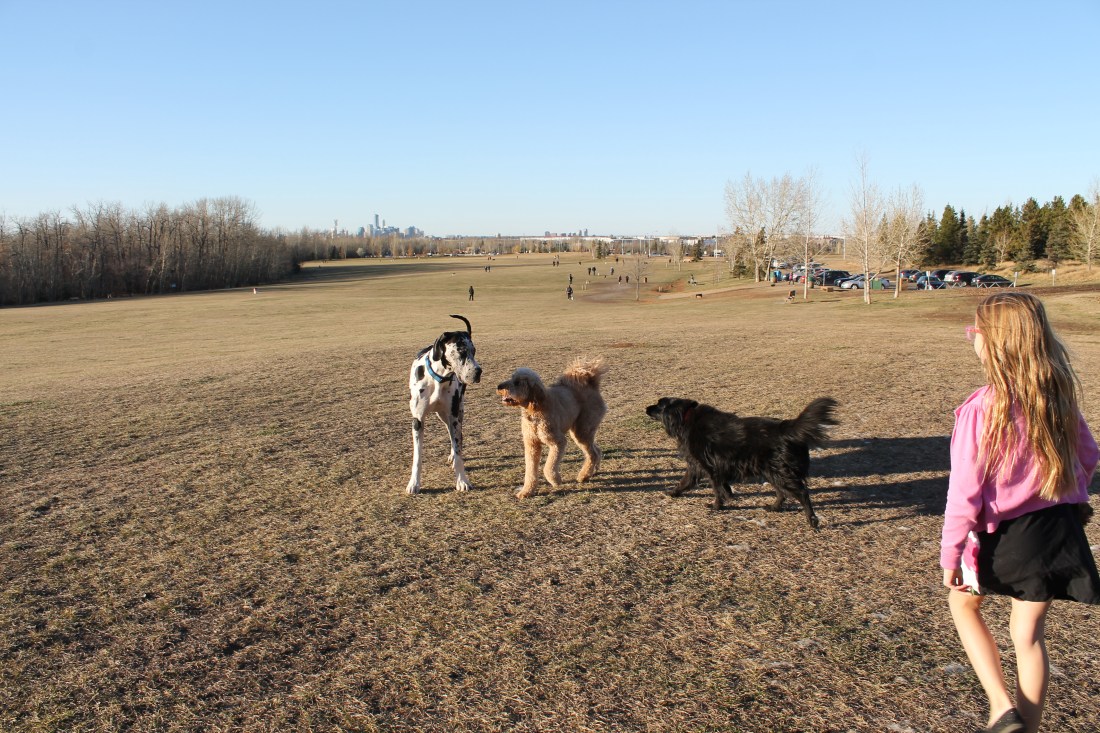
I finished The Nix a few weeks ago, and I miss it. It’s a 22 hour listen on Audible or a 600+ page read – perfect for avoiding Sabbatical writing or the constant barrage of pandemic news. The heartbreaking yet hysterical life of Community College English Professor Samuel Anderson-Andreson entertained me every day while Poppy and I journeyed through several of Edmonton’s dog parks. Frequently dog companions gave me side looks as I passed them literally laughing out loud. Poor Poppy was forced to walk countless extra kilometres when we would get back to the car, then suddenly take another lap because I couldn’t take off my headphones until I digested one more chapter.

Nathan Hill is an extraordinary master of satire who somehow manages to weave three different yet coherent stories of comedic tragedy into this intergenerational exploration of college life during the distinct eras of the Boomers, Gen X, and Millennials. My favourite scene involves Samuel’s struggle to address a plagiarized paper with Laura Pottsdam, a stereotypically entitled millennial student who manages to unconsciously utilize every conceivable logical fallacy in her attempt to avoid consequences. She eventually gets away with it when she convinces Samuel’s Dean that he caused her to experience “negative feelings of stress and vulnerability.” Samuel’s only escape – from his students, from the book he is supposed to be writing (and for which he already received an advance), from the pain of his mother abandoning him, and from the loss of the only girl he will ever love – is a video game called ElfScape. His best friends are people he has never met in the real world. But then his mom re-enters his life through the television via a ridonkulous political drama that plays out on the national American stage, and which engulfs him in a pilgrimage to understand his past. The story moves back and forth in time as the mysteries of Samuel’s genealogy illuminate his tragic life. Hill manages to weave a tapestry integrating themes like friendship, love, addiction, abandonment, loneliness, identity, vocation, female oppression, frozen food, war, and politics in settings as far-ranging as pre-World War II Norway, the 1968 Chicago Democratic Convention, post-911 Iraq, and the Occupy Wall Street movement.

The Nix is fitting pandemic reading because Hill has a way of illustrating the paradoxes of our contemporary world through the developing eyes of childhood, young adulthood, middle age, and senility. As we social distance for the sake of our parents and grandparents, this novel may be a helpful lens to consider what is truly important in life – and what is not.