My son Brendan and I are reading the book Collapse together while we are social distancing. (Look for a recommendation on this one down the road). His favourite chapter thus far has been about Easter Island, where the population used all the resources at their disposal in a tribal race to honour their ancestors through what Brendan calls Yum-Yum heads. Author Jared Diamond queries what the person who cut down the last tree might have been thinking. Likely they were so entrenched in the ideology of the time they were not cognizant of the consequences: starvation and the loss of 90% of the population.
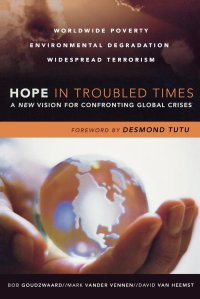
This post is part two in a longer than usual recommendation for the book Hope In Troubled Times by Bob Gouzwaard, Mark Vander Vennen and David Van Heemst. Yesterday I addressed idolatry through the lens of the book and recent opinions that the US should jump-start the economy by Easter. Today I’m looking at how this may reveal one of the dominant ideologies of our day.
In the volume, ideology is defined as “the entire set of conceptions and beliefs subscribed to by a specific group of people.” (32) It can also mean “a deliberate political attempt to systematically regulate or manipulate people’s currently held ideas in order to achieve certain societal ends.” (33) Ideology has three primary components:
- Absolutized political or societal end goals.
- A redefinition of currently held values, norms and ideas to such an extent that they legitimize in advance the practical pursuit of the predetermined end.
- Establishing a standard by which to select the means or instruments necessary for effectively achieving the all-important goal. (33)
The core idea is that within an ideology, the end goal becomes paramount, and anything getting in the way of that goal is ascribed as evil. The authors use the French Revolution, Nazism, and Communism as examples, demonstrating how each was crafted toward a non-negotiable end and had specific people or ideas that were considered evil. In Nazism, for example, the Jews were declared to be evil itself because they opposed the overarching end. (34) The authors go into considerable detail on the phases of ideological development: conception, actualization, (re)construction, domination, terror, dissolution. (52-55) There is more on ideology than I’m going to describe here, which is why this is a book recommendation. Check it out!
Of interest today is one of the four ideologies that Goudzwaard et al. argue exist in our current era: “The pursuit of more material wealth or prosperity and the opportunity for continued material progress.” (38) To be fair, the authors are not entirely convinced material progress and prosperity are full-fledged ideologies in the same sense as Communism or Nazism. They call for caution. Nonetheless, they cite some interesting trends that point to the existence of an ideology, beginning with socioeconomic paradoxes that border on absurdities.
- The poverty paradox: “Despite an unprecedented expansion of wealth, recent years have witnessed unpredicted increases in situations of deepening poverty.” This is the case not only in developing nations but in the world’s richest countries. “If material prosperity expands in a country, then why has poverty not been alleviated in tandem with that expansion?” (87)
- The care paradox: “Opportunities for extending care are steadily eroding in increasingly wealthy societies.” We are seeing the realities of this right now in the pandemic. Countries like the US should be the most financially prepared for such a disaster. Clearly, this is not the case. (87)
- The time paradox: Prosperity should bring more free time for leisure and the enjoyment of wealth. However, at least before social distancing measures, our pace has accelerated, and the effects of stress and burnout are evident.
- The environment paradox: “The application of improved technologies, more economic resources, and a series of international agreements has not been able to turn the tide of environmental destruction.” (88)
The authors root these paradoxes within the tensions between dynamism and production – “the tension between what can progress and what can scarcely progress.” (90) Poverty results because many in society cannot keep up with the pace of change due to structural, educational, or economic factors. Care as an economic activity cannot keep up because the costs and prices of service increase proportionately faster than productive sectors. Society tends to view anything economically stationary as regressive. This means the only real response available to the care sector in this paradigm is to find ways to increase efficiencies, which means less staff and equipment (as continuously seen in the news this very day). Things are worse for the time paradox and environment paradox as these are impediments to increased productivity. These paradoxes cannot be solved by more money, technology or science precisely because they flow out of “the excess of the forces of unlimited development.” (91)
The ideological conclusion: “The spreading scourge of paradoxes in our society is a sign or signal that our society does not allow the negative and even risky consequences of paradoxes to overrule the belief that, above all, else, the current dynamism must be sustained and expanded.” (91) More succinctly, we live within an ideology of endless progress. The means of this progress are the economy, technology and science. The idea that we must keep progressing has become an absolute end that seems irrefutable to many. Progressives arguing for the preservation of the environment or social justice become evil opponents in this ideology. It is not surprising that we are willing to sacrifice 1 to 3% of the population in America if those individuals, who are not economically productive, put the ultimate end of the ideology at risk. The economy simply must grow, and we must become more prosperous. There is no alternative.
Tomorrow I’ll look at how the realization of and repentance from this ideology can lead to hope in these troubled times.



 Michael Ferber