The bright morning star and the fruit tree: metaphors for hope in these troubled times

Pandemic Book Recommendation #9, Part 3: Hope

Part 2: Ideology

Part 1 Idolatry

Every day during this pandemic, I find it more difficult to see hope, especially when it comes to COVID-19’s spread across America. My oldest daughter is in Phoenix, and my family, including my parents, are spread across West Virginia and Kentucky. The slow daily crawl watching the case numbers climb is like a dawdling spiritual poison from a drug that takes weeks to finish its work.  Nonetheless, hope is always available if we are willing to seek it out. I’m trying. Bob Gouzwaard, Mark Vander Vennen and David Van Heemst remind us that hope is real because, “at its core, it is not a human creation. It attaches itself directly to the faith that God is deeply engaged in all of human history.” (172)

The conclusion of their book contains themes and metaphors of hope that apply to the tragic realities of pandemic. Some of their tropes are extraordinary and have consumed a few classes worth of past discussions in my courses. There is no space here for unpacking the circle and the cross (175), the periscope (181), the minesweeper (184), or the rope-ladder (187). Here I will only stick to two that seem most pertinent.

The Morning Star

There are beautiful signs of hope in the form of front-line health care workers sacrificing their own lives and safety to serve others – but even these stories exist in the context of tragedy. My Facebook feed is awash in the language of fear, blame and shock. When will this end? Where is God?

The authors of Hope in Troubled Times remind us that “Christian hope is a hope of contrast: it revives in the middle of the night, just when darkness seems to overpower us.” (176) They use the Biblical image of the morning star, which appears at the bleakest hours of the night, as a demonstration of the defeat of darkness. When the star appears, the morning is behind it. In the last words Jesus spoke to his disciples, he proclaimed, “I am… the bright morning star.” (Rev. 22:16)

The book of Esther in the Bible does not contain a mention of God. Yet, Esther’s name means “morning star.” She lived when the elimination of Israel appeared as fate. God seemed absent – but was there all along. “Miracles did not save Israel, at least not miracles as we understand them. But as a God who works hiddenly, God linked his saving acts to the act of Esther, who in obedience put her own life in jeopardy… When Esther is seen in the darkness of exile, that is the sign of daybreak. Where God in his hiddenness can be delineated, there is sign that the defeat of the night has come.” (177) Our front line health care workers are the Esthers of our day – the bright morning stars revealing the light that, though dim now, is soon to awaken the morning.

The Fruit Tree

I have suggested through the lens of this book that we are living in an age in which progress and material prosperity is the reigning ideology, perhaps to the point where economic growth has become an idol. This tragic pandemic can act as a catalyst for us to search our hearts about how we want to live in the coming post-COVID-19 world. The authors provide the fruit tree as a helpful metaphor in this regard.

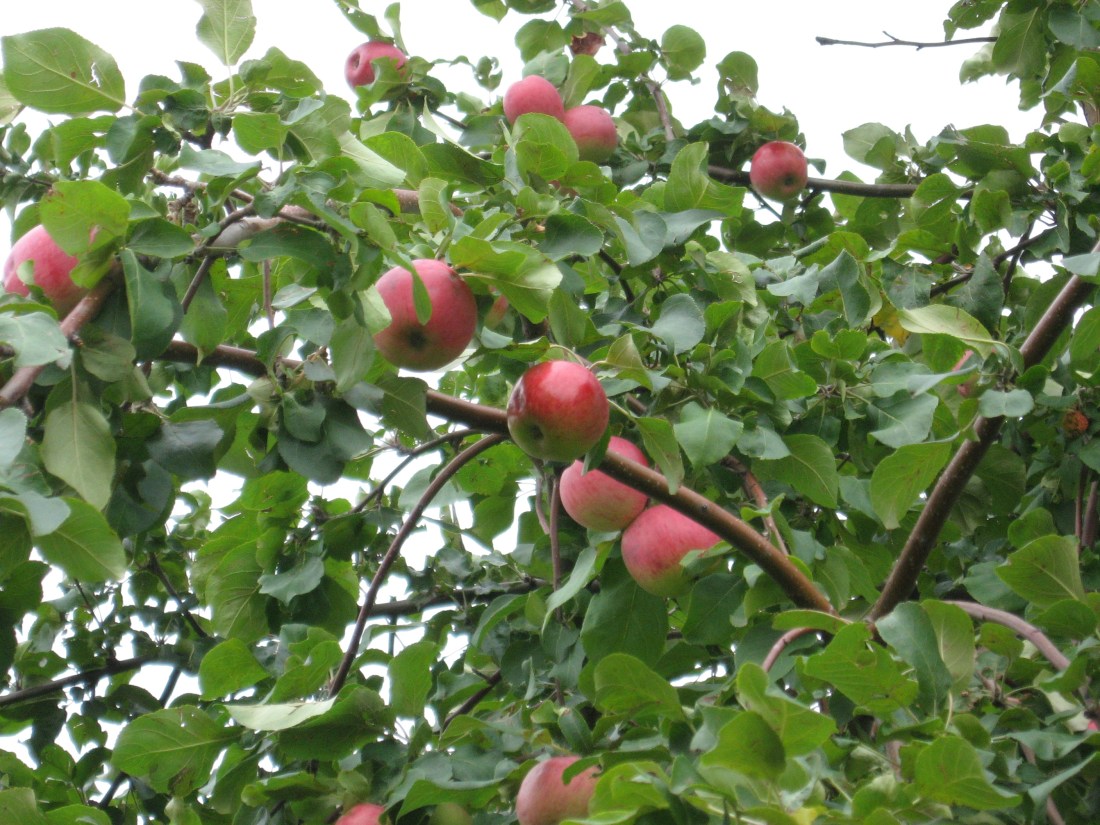
“No fruit tree is inclined to grow infinitely in height. If it did so, it would have to jettison all of its inefficient cells. It would have to put greater pressure on the soil and forgo the production of fruit entirely. Instead, at a certain point a fruit tree exercises built-in wisdom to redirect its growth energies away from expansion in height and toward the production of fruit. It reaches a saturation point and recognizes it as such. This allows the tree to create room to build up reserves and then to redirect its growth energies toward the production of fruit.” (191)

Like fruit trees, our economies – at the scales of the household and the nation – were not intended to grow infinitely forever. Like trees, we arrive at saturation points in which we have a choice to re-orient our energies toward the production of fruit rather than infinite growth. The authors suggest we “take one decisive, perhaps painful, but also realistic step back from the economic goal that hypnotizes us.” On the other side of this pandemic, we can choose to develop a pre-care economy as opposed to a post-care economy. This would place care needs first rather than last on a list of priorities. We could turn away from simplistic material expansion and toward sustainable economies that build community, meet the needs of the poor, and invest in the preservation of culture and the environment. Perhaps one of our problems is that “we have failed to imagine that the world can operate in any other way.” (192)
Pandemic Book Recommendation #9: Hope in Troubled Times, Part 1: Idolatry

I started this blog as an attempt to stay mentally healthy and positive during a time of social distancing. Many others have used social media as a platform for humour in this time of trial, and I’ve enjoyed seeing and relating to the many Facebook memes involving homeschooling, cats and social distancing. It worked for a few days. But two days ago I “popped” watching events unfolding in my home country. The context involved the government abandoning the advice of health experts and reopening the US economy to jump-start economic growth.

In the late evening of March 23, I posted the following on Facebook, “What we saw today in President Trump’s speech reveals the true god America worships. What do you say about a society that is willing to offer human sacrifices to appease the invisible hand of the market so we can all go back to consumption at the malls and prosperity in the stock market? Sacrifice the creation to this god – of course! Sacrifice the poor – no problem! Now we also appear to be willing to sacrifice our parents and grandparents. When will we confess and repent?”

Needless to say, this post started a bit of a discussion – and not much of it was touchy-feely or positive. The statement encapsulates a breadth of literature that is worth considering in these difficult days of pandemic. So, I’m going to step away from the positive self-help books for a few days and try to be a bit more prophetic in this blog. No matter your religious persuasion (or the lack thereof), consider looking at the monumental decisions being made in the United States through the lens of idolatry.

In 2007 Bob Gouzwaard, Mark Vander Vennen and David Van Heemst wrote Hope for Troubled Times: A New Vision for Confronting Global Crises. The volume is as important today as it was a decade ago when I started using it in some of my courses. I’m not going to provide a full review of it here, but rather use the book as a lens to consider how our current reliance on progress and economic growth could be an idol, in the fashion of the gods our ancestors would have crafted from wood or stone. I’ll make subsequent posts linking this idolatry to ideology, and then discuss hope for moving forward.

To start, the authors do assert that nothing is inherently evil about the economy, money or the market (170). Nonetheless, like wood or clay, these things can be formed into an apparatus to be worshiped. They describe three steps through which idol worship unfolds. First, people objectify the god using material available in order to bring the god closer. The image acts as an access point or gateway to the divine. Then people venerate the idol by bringing it sacrifices. Finally, people gradually become “reshaped and transformed into the likeness of their gods” (40).

Idols have mouths, but cannot speak,
Eyes, but they cannot see;
They have ears, but cannot hear,
Noses, but they cannot smell;
They have hands, but cannot feel,
Feet, but they cannot walk;
Nor can they utter a sound with their throats.
Those who make them will be like them,
And so will all who put their trust in them. (Ps. 115:5-8)

The authors assert that fear is what drives the final step. The image of their god may remain opaque, but its representation becomes very real. “The power that people delegate to the idol is a power that both saves and destroys. As such, it instills deeper and deeper anxiety. The slightest misstep can trigger the wrath of the idol, a wrath that may bring people to ruin. Serving idols therefore always brings with it a form of hypnosis, a hypnotic narrowing of consciousness. People’s perception of reality shrinks into a matter of merely finding the right type of interaction with the idol. But by then the god has, to some extent, assumed control: it now largely charts its own autonomous course. When that occurs, fear becomes the chief characteristic of life, and the sense of betrayal is pervasive.” (41)

Today it is quite common to hear the market described using terminology usually reserved for the religious realm. This involves not only the market’s saving power but also the sacrifices needed to maintain it.

– “We must follow the dictates of the market.”
– “Only economic growth can save us.”
– “All groups in society need to make sacrifices for a better future.” (97)

We are hearing this very language right now in the debate to jump-start the economy at the expense of the lives of front line health care workers and seniors. These sound profoundly religious, and this is not accidental. “It hints at decisions made about ultimate meaning, done either openly or unconsciously, without which people do not see life as feasible. Imitation saviors still move among us, and we see them as entitled to demand sacrifices.” (98)

Goudzwaard et al. make a strong argument that in the west, we are now trapped inside the cocoon of a perspective that will only consider solutions in line with the way we define progress (25). We have become consumed and obsessed with reaching our goals regardless of the cost. They argue that this is idolatrous in the sense that we exalt our goals of endless progress and material prosperity as the very powers that will deliver us to this end. In this manner, we have become dependent on our creations. But at a cost!

“The gods never leave their makers alone. As soon as people put themselves in a position of dependence on their gods, invariably the moment comes when those things or forces gain the upper hand, when they begin to mold the lives and thoughts of their adherents. Humanly made things or forces begin to control their makers even to the point where they become powers of domination. Against them the human will weakens or even vanishes, while the initial goals tend to become bleak, obscured, or forgotten, building in the moment when the gods’ betrayal becomes transparent. But by then it could be too late.” (27)

These times call for serious introspection and reflection. The economy is a social construct. Have we crafted a god in the form of material prosperity? If so, are we truly willing to pay the price of tribute? Are we so obsessed with our individual net worth and our collective GDP that we are willing to make this level of sacrifice to jump-start the economy? The rest of the world is prioritizing the lives and wellbeing of citizens – the very things the market was originally intended to enhance. Will America offload its responsibilities to fellow citizens and allow a false god to dictate the horrible sacrifices required? If so, can we continue to claim that America is a Christian nation?

Coming Up:
Part 2: Ideology
Part 3: Hope in Troubled Times