Who Do We Choose To Be? Part 1: Collapse

If you can even call it a debate, last night’s toddler-like banter was troubling in every way – a low point in American politics in an already upsetting time. In my sleepless night processing the debacle, I’ve been continually reflecting on Margaret Wheatley’s 2017 leadership book: Who Do We Choose To Be?

Wheatley draws on two disparate kinds of literature to “summon us to be leaders for this time as things fall apart, to reclaim leadership as a noble profession that creates possibility and humaneness in the midst of increasing fear and turmoil.” (8) The two lenses are the science of living systems and the pattern of collapse of complex civilizations.

The book is not a hopeful volume. Wheatley has rejected altogether what she describes as the ambush of hope. She believes it is too late for this, at least at the global or in America the national scale. She laments, “I’ve read too many authors who lay out the reality of our situation in stark detail, but then in the last pages feel the need to say something hopeful even though it contradicts their own argument. I have no interest in grasping after or reviving possibilities that have already passed. I have an intense desire for us to step forward as leaders for this time, hearts and minds fully open and wise, in service to whomever needs us.” (22)

Early in the volume, she requests that readers approach the book using a “Dwelling Mind.” In my reading, I followed this advice and took the time to pause and reflect on each section. The hard copy is laid out in a way that makes this easy – it is a work of art. I found her words to be true: “If we dwell with the increasing uncertainty of this time and not rush to that comfortable place of action, dwelling mind supports the emergence of clarity for our chosen role as leaders.” (23)

As last night’s debate makes clear for America, and a cursory glance through global headlines reveals for most nations of the world, we are in a time of decline. Reading lines like this invokes pain and fear, and optimists like me want to grasp for the line of hope that we expect to be next. Where is the “But…”? Wheatley encourages us to mindfully face the reality that is so obviously before us. “We can no longer solve the large-scale global problems of this time at large-scale levels: poverty, economics, climate change, violence, dehumanization. Even though the solutions have been available for a very long time, they require conditions to implement them that are not available: political courage, collaboration across national boundaries, compassion that supersedes self-interest and greed. These are not only the failings of our specific time in history; they occur in all civilizations at the end of their life cycle.” (10)

Drawing upon historians such as Sir John Glubb and Joseph Tainter, Wheatley walks the reader through the stages of collapse that have characterized societies throughout human history. Glubb summarizes these stages that tend to run their course in ten generations or about 250 years. They include 1. Age of Pioneers. 2. Age of Conquest. 3. Age of Commerce. 4. Age of Affluence. 5. Age of Intellect. 6. Age of Decadence. The final two, which Glubb described in his book in 1976, are worth considering verbatim from Wheatley:

Five – Age of Intellect: “The arts and knowledge flourish in the midst of decline. Intellectuals are prevalent and engage in incessant talking as a substitute for action. The belief takes hold that problems can be solved by mental cleverness rather than selfless service and courage. Natural sciences advance but do not prevent decline. Civil conflict increases even as the empire is under dire threat. Instead of banding together to preserve the nation, internal political fractions seek to destroy one another.” (36)

Six – Age of Decadence: “Wealth and power have led to petty and negative behaviors, including narcissism, consumerism, materialism, nihilism, fanaticism, and high levels of frivolity. A celebrity culture worships athletes, actors and singers. The masses are distracted by entertainment and sporting events, abandon moral restraint, shirk duties, and insist on entitlements. The leaders believe they are impervious and will govern forever. This age also develops the welfare state as imperial leaders generously build universities and hospitals, give grants to university students, support the young and the poor, and extend citizenship to everyone. When they run out of money, all this benevolence disappears and these institutions shut their doors.” (36)

We’re likely past the tipping point for many of the challenges confronting our civilization. The fires on the west coast and hurricanes on the east in yet another record warm year should serve as a wake-up call that, if there is time to slow down anthropogenic climate change before the great barrier reef is bleached and the Greenland ice sheet slides into the sea, that time is quickly fading. We are in the midst of the sixth great mass extinction on the planet – and we are the cause. Yet we continue to ignorantly blaze into the future in a fog of faith that our technological sophistication and the myth of progress will save us. But we are blind. “Lost in the seduction of technical creativity, we fail to see what else is going on. What’s happening in society to relationships, to poverty, to violence, to alienation? What’s happening to our land, our traditions, our people? Why have more than 65 million people fled their home countries and now live as refugees? What’s being done to address our enduring human needs for home, for community, for contribution, for good work, for safe children? And what about our planet?” (41)

Wheatley rejects the capacity of global and national leaders to do anything about these challenges. “The powerful always defend the status quo because it is the source of their power and privilege. Any change that benefits others would destroy their position. And their position is all they care about defending.” (10) Her hypothesis is not encouraging and is best received with a spirit of mindful resolve or bourbon. “For those not blinded by the false promise of progress, we may understand the dire state of this civilization. If you’re paying any attention to the news from everywhere, it’s hard to avoid the specter of collapse.” (32)

If Wheatley is correct and we are in the final phase of Glubb’s stages, this is a moment for each of us to slow down and ask fundamental questions about what it means to be human in this time, and particularly what it means for our domains of leadership. We could choose to bury our heads in the sand and lose ourselves to withdrawal, suppression and denial – or we can choose to step into these times with sober-minded resolve. “Do we, as most do, fall into private collapse consumed by fear and despair? Do we become one who does nothing but complain for what has been lost? Do we succumb to grief for the suffering of so many? Do we give up and pursue whatever time is left in hedonistic pursuits? Do we cocoon in self-protection bubbles with a nine-foot TV screen and Surround Sound? . . . Or do we acknowledge where we are and step forward to serve?” (32)

If 2020 is any indication of what is in store for us, 2021 will not be much better. “Systems that are failing now will continue to deteriorate. Uncertainty, confusion, and fear will continue to predominate. People will withdraw further into self-protection and strike out at those different from themselves. Corrupt leaders will intensify their false promises, and people will subjugate themselves to their control. The chaos cycle predicts this has to happen, that things must fall apart. And human history documents in astonishingly clear detail the pattern of collapse that all civilizations go through.” (8)

How, then, should we react? For Wheatley, “Blind reactivity and fear is not the answer. Self-protection is not the answer. Denial is not the answer. Sane leadership is.”

What is sane leadership? That deserves its own post, and I’ll provide it shortly. But first, I’ll walk you through how I came across Wheatley’s work in the first place through a second post on emergence.

More soon…

Part 2: Emergence
Part 3: Islands of Sanity

Embracing Vulnerability in Pandemic

Pandemic Book Recommendation #16: Strong and Weak by Andy Crouch

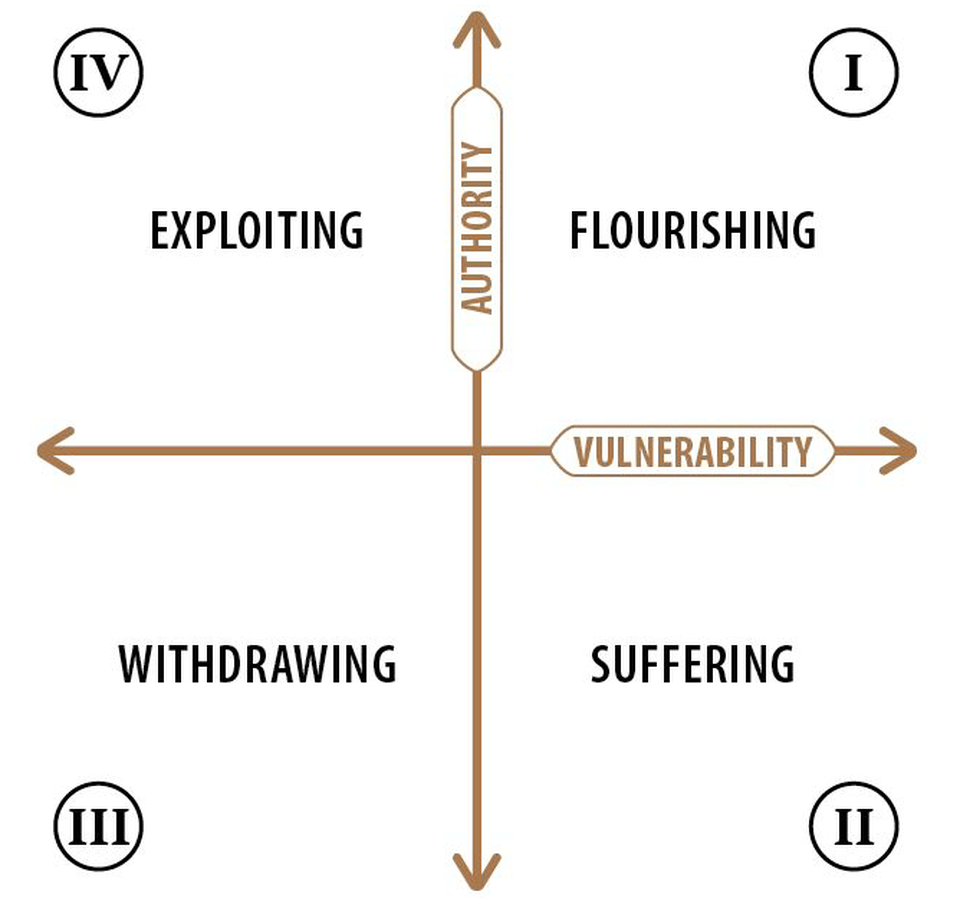
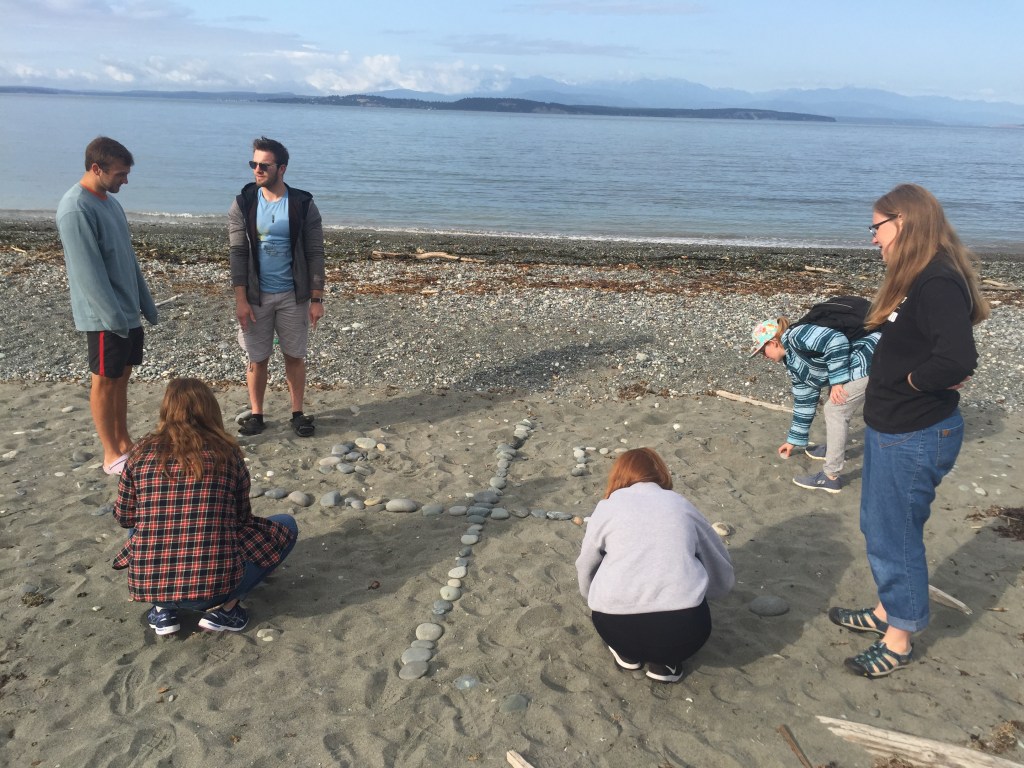
Strong and Weak is another book I use with my Au Sable International Development class each summer. Instead of assigning it as required reading, we dissect it during one of our beach discussions. In the book, Andy Crouch provides a fantastically profound yet straightforward 2X2 paradoxical grid juxtaposing authority with vulnerability. The paradox is that authority and vulnerability are not opposites but exist best together. In the class, we recreate the grid using rocks on the beach, then leave it for others to wonder about what kind of pagan ceremony occurred there.

In the grid, authority can be interpreted as power – similar to the kind of power discussed in my last review of Playing God. Strong and Weak is the sequel, and Jayakumar Christian continues to play an inspiring role. In Crouch’s model, the higher on the grid you are, the more self-efficacy you possess and the more capacity you have to exert authority over others. The further on the right you exist on the grid, the more vulnerable you are. So if you are in the lower left quadrant of “withdrawing,” then you may live like a character in the Wall-E movie, on an eternal cruise in which you are completely safe but also not using your God-gifted authority to make the world a better place. In the bottom right, you would have no power and be highly vulnerable; thus, you would be “suffering.” In the upper left, you might have extraordinary authority, but if you are not also vulnerable, then you become “exploiting.” Finally, Crouch describes the upper right quadrant as “flourishing” – being in a place of BOTH authority and vulnerability.

You need to read his short book to get the whole picture. In summary, Crouch uses Jesus Christ as a model to demonstrate the flourishing life as one of both authority and vulnerability, and he does this again through the lens of Philippians 2. When either authority or vulnerability is absent — or when both are missing — we find distortions in humans, organizations and institutions. Instead of flourishing, we create cultures immersed in suffering, withdrawing and exploiting. Leaders today need to be both strong and week – wielding authority with vulnerability.

The pandemic has created a situation in which nearly all of us find ourselves suddenly moving around on this grid. We may be unemployed, laid off, and financially vulnerable. Some of us are also vulnerable to the virus itself – our lives are literally in danger. We are collectively moving toward the bottom of the quadrant as the efficacy we had to determine our future erodes. A few of us may be fortunate enough to settle into the bottom left – to have the means to withdraw into video games or Netflix. Many of us, though, are suffering in the lower right quadrant – powerless to the changing world.

In this context, we are faced with a unique opportunity to follow in the footsteps of Jesus. We can do this in two ways.

First, we can ask ourselves whether our loss of power/authority is ultimately the loss of an idol and not a loss of efficacy in its own right. Have we been putting our hope and trust in our wealth? If so, the threat of losing it is tantamount to losing confidence in having a good future. The danger here is that we might spring into action to do whatever is necessary to protect that in which we trust. Crouch writes, “In the grip of idols, we believe that our problem is not enough authority. Life becomes a quest to acquire enough authority to manage and minimize our vulnerability… To people who see the world this way, gaining authority without vulnerability is the pearl of great price, something you would sell everything to obtain.” Crouch’s advice for us – if we find ourselves here – is as simple yet profound as his grid: relinquish power and confess sin.

“Therefore I tell you, do not worry about your life, what you will eat or drink; or about your body, what you will wear. Is not life more than food, and the body more than clothes? Look at the birds of the air; they do not sow or reap or store away in barns, and yet your heavenly Father feeds them. Are you not much more valuable than they? Can any one of you by worrying add a single hour to your life?  Matthew 6:25-27

Second, we can embrace our vulnerability as Christ embraced his. Crouch reminds us that the story which turned the world upside down is not a story of ultimate power made manifest, but of ultimate vulnerability to the point of dying on a cross. To become like Christ, what we are missing is not more authority, but more vulnerability. This is not trite, as many are experiencing the agony of the Garden of Gethsemane amid tragic loss. But we do not suffer alone. Christ has gone before us. He can be our model and even our companion on the journey. 

The pandemic is likely not going to be a short trial. On a podcast last week, Andy described how many Christian leaders seem to be looking at this pandemic as though it is a blizzard, suggesting we need to hunker down for a few days, then it will be over. He argues, based upon well-informed sources, that this will more likely be a full winter, if not even a mini ice age. Some, wishing this to be a blizzard and bent on the need for invulnerable authority, are already up in arms. Many of these individuals are Christians, and many pastors are encouraging their flocks to disregard the government and stand up for their God-given rights of freedom. The motto of West Virginia, my home state, is montani semper liberi – mountaineers are always free. The lockdown appears to many friends on my social media feed as an attack on liberty. But in the spirit of Strong and Weak, forcing our will while putting others at risk is not a Christian response. It is rooted in fear. If we want to be agents of transformation in the world today, perhaps we should take a lap through Strong and Weak before grabbing an assault rifle and heading to the capitol. There is a way to bear the burden of authority with vulnerability, and this book can help us find it.  

Hope in Troubled Times, Part 2: Ideology

My son Brendan and I are reading the book Collapse together while we are social distancing. (Look for a recommendation on this one down the road). His favourite chapter thus far has been about Easter Island, where the population used all the resources at their disposal in a tribal race to honour their ancestors through what Brendan calls Yum-Yum heads. Author Jared Diamond queries what the person who cut down the last tree might have been thinking. Likely they were so entrenched in the ideology of the time they were not cognizant of the consequences: starvation and the loss of 90% of the population. 

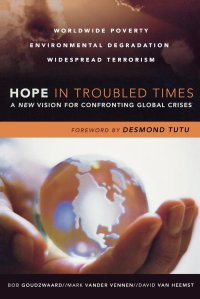
This post is part two in a longer than usual recommendation for the book Hope In Troubled Times by Bob Gouzwaard, Mark Vander Vennen and David Van Heemst. Yesterday I addressed idolatry through the lens of the book and recent opinions that the US should jump-start the economy by Easter. Today I’m looking at how this may reveal one of the dominant ideologies of our day.

In the volume, ideology is defined as “the entire set of conceptions and beliefs subscribed to by a specific group of people.” (32) It can also mean “a deliberate political attempt to systematically regulate or manipulate people’s currently held ideas in order to achieve certain societal ends.” (33) Ideology has three primary components:

  1. Absolutized political or societal end goals.
  2. A redefinition of currently held values, norms and ideas to such an extent that they legitimize in advance the practical pursuit of the predetermined end.
  3. Establishing a standard by which to select the means or instruments necessary for effectively achieving the all-important goal. (33)

The core idea is that within an ideology, the end goal becomes paramount, and anything getting in the way of that goal is ascribed as evil. The authors use the French Revolution, Nazism, and Communism as examples, demonstrating how each was crafted toward a non-negotiable end and had specific people or ideas that were considered evil. In Nazism, for example, the Jews were declared to be evil itself because they opposed the overarching end. (34)  The authors go into considerable detail on the phases of ideological development: conception, actualization, (re)construction, domination, terror, dissolution. (52-55) There is more on ideology than I’m going to describe here, which is why this is a book recommendation. Check it out!

Of interest today is one of the four ideologies that Goudzwaard et al. argue exist in our current era: “The pursuit of more material wealth or prosperity and the opportunity for continued material progress.” (38) To be fair, the authors are not entirely convinced material progress and prosperity are full-fledged ideologies in the same sense as Communism or Nazism. They call for caution. Nonetheless, they cite some interesting trends that point to the existence of an ideology, beginning with socioeconomic paradoxes that border on absurdities.

  1. The poverty paradox: “Despite an unprecedented expansion of wealth, recent years have witnessed unpredicted increases in situations of deepening poverty.” This is the case not only in developing nations but in the world’s richest countries. “If material prosperity expands in a country, then why has poverty not been alleviated in tandem with that expansion?” (87)
  2. The care paradox: “Opportunities for extending care are steadily eroding in increasingly wealthy societies.” We are seeing the realities of this right now in the pandemic. Countries like the US should be the most financially prepared for such a disaster. Clearly, this is not the case. (87)
  3. The time paradox: Prosperity should bring more free time for leisure and the enjoyment of wealth. However, at least before social distancing measures, our pace has accelerated, and the effects of stress and burnout are evident.
  4. The environment paradox: “The application of improved technologies, more economic resources, and a series of international agreements has not been able to turn the tide of environmental destruction.” (88)

The authors root these paradoxes within the tensions between dynamism and production – “the tension between what can progress and what can scarcely progress.” (90) Poverty results because many in society cannot keep up with the pace of change due to structural, educational, or economic factors. Care as an economic activity cannot keep up because the costs and prices of service increase proportionately faster than productive sectors. Society tends to view anything economically stationary as regressive. This means the only real response available to the care sector in this paradigm is to find ways to increase efficiencies, which means less staff and equipment (as continuously seen in the news this very day). Things are worse for the time paradox and environment paradox as these are impediments to increased productivity. These paradoxes cannot be solved by more money, technology or science precisely because they flow out of “the excess of the forces of unlimited development.” (91)

The ideological conclusion: “The spreading scourge of paradoxes in our society is a sign or signal that our society does not allow the negative and even risky consequences of paradoxes to overrule the belief that, above all, else, the current dynamism must be sustained and expanded.” (91) More succinctly, we live within an ideology of endless progress. The means of this progress are the economy, technology and science. The idea that we must keep progressing has become an absolute end that seems irrefutable to many. Progressives arguing for the preservation of the environment or social justice become evil opponents in this ideology. It is not surprising that we are willing to sacrifice 1 to 3% of the population in America if those individuals, who are not economically productive, put the ultimate end of the ideology at risk. The economy simply must grow, and we must become more prosperous. There is no alternative.

Tomorrow I’ll look at how the realization of and repentance from this ideology can lead to hope in these troubled times.